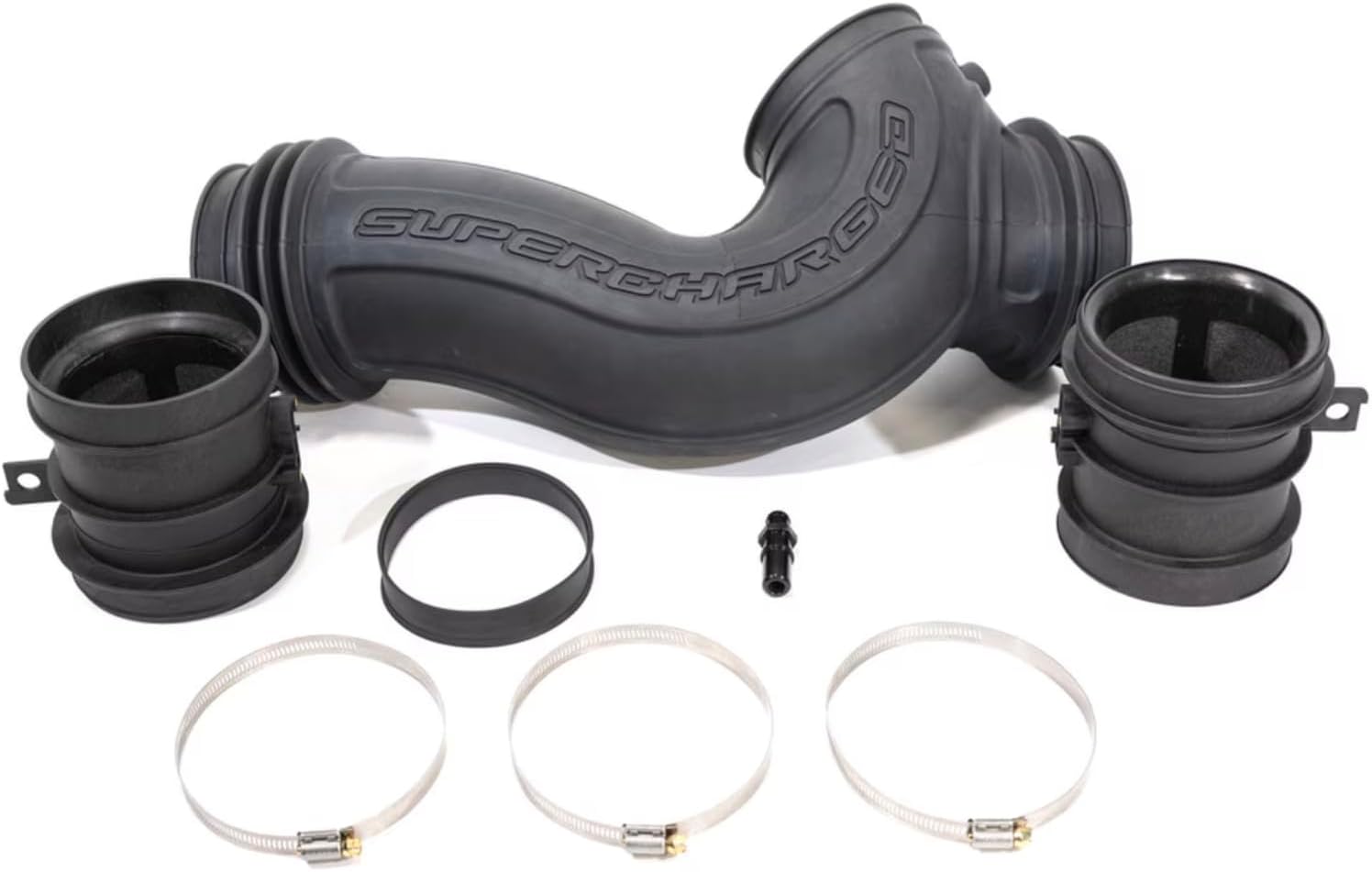
A supercharger is an engine-driven air pump. It forces more oxygen into your engine’s cylinders than the motor could pull in on its own — and more oxygen means you can burn more fuel, which means more power. Unlike a turbocharger (which is spun by exhaust gases and builds power with a delay), a supercharger runs off a belt connected to the crankshaft, so boost — the pressurized air charge — arrives the instant you press the throttle. That instant response is why superchargers dominate street performance and road-racing builds. If you’re sitting on a stock LS truck, a Coyote Mustang, or a 7.3-liter Godzilla F-250, a bolt-on supercharger kit is the single highest-impact upgrade you can make. This guide breaks down what VMP, Whipple, and Roush kits actually make at the wheels — not marketing claims, but published dyno sheets and aggregated owner data — so you can make a confident decision before you write the check.
The Three Platforms, the Three Brands, and Why the Numbers Actually Differ
Before we get into individual kit numbers, you need to understand one thing that almost every marketing page glosses over: dyno numbers are meaningless without context. A wheel horsepower (whp) figure — the power measured at the driven wheels after accounting for drivetrain losses — will vary based on whether the car was dynoed on a Mustang AWD dyno versus a Dynojet, what octane fuel was used, ambient temperature, and whether the tune was a conservative street map or an aggressive race calibration. A car that makes 620whp on a Mustang dyno might show 680whp on a Dynojet under identical conditions.
That said, published manufacturer dyno sheets and repeated independent owner pulls give us reliable relative comparisons within the same chassis and dyno type. That’s what we’ll use here.
The three platforms we’re covering — GM’s LS family (specifically Gen IV 6.0L and 6.2L), Ford’s 5.0L Coyote (Gen 3, 2018–2023 Mustang GT), and Ford’s 7.3L Godzilla (2020–present F-250/F-350 Super Duty) — each respond to boost differently because of compression ratio, port geometry, and factory fuel system capacity. The LS 6.2L runs 10.7:1 compression; the Gen 3 Coyote runs 12.0:1 (requiring careful boost management on pump gas); the Godzilla sits at a more boost-friendly 10.5:1 with enormous displacement on its side.
Coyote Mustang: VMP Gen3R vs. Whipple W175FF vs. Roush Phase 2
This is the most crowded, most documented supercharger market in the country. All three of these are positive-displacement twin-screw units — meaning they use two meshing helical rotors to compress air internally before it ever sees the intake manifold, producing immediate boost with no surge behavior.
VMP Gen3R TVS 2300
VMP Performance’s Gen3R kit uses a Eaton TVS 2300cc rotor pack and targets the 2018–2023 Mustang GT (Gen 3 Coyote, 5.0L). Per VMP’s published dyno documentation, on a stock bottom-end Gen 3 with 93-octane fuel and VMP’s base tune, dyno pulls show 580–620whp on a Dynojet with the 8-rib pulley configuration. Owners on upgraded flex-fuel tunes consistently report breaks into the 650–680whp range with E85 blending. The kit retails around $7,200–$7,800 as of Q1 2026, including intercooler, inlet, and base calibration. VMP rates the kit as supporting up to 700+ whp with supporting fuel mods (upgraded injectors, dual pump or Fore Innovations fuel system). Motortrend’s 2024 comparison of Mustang GT supercharger kits specifically cited VMP’s plug-and-play harness integration as a differentiator for shops looking to minimize tune-in time.
Whipple’s Gen 5 3.0L kit is the displacement king in this class. Per Whipple’s published product sheet, a bone-stock 2018–2023 Mustang GT with the Stage 1 kit and 93-octane calibration comes off the dyno at 635–660whp on a Dynojet. With a Stage 2 tune on E85, Whipple’s own published documentation lists peak numbers as high as 725–745whp on stock rotating assembly — an aggressive claim, but one independently corroborated by engine shops across repeated pulls documented on dragzine.com and superstreetonline.com in 2023–2024. The kit price is higher: $8,500–$9,200 installed-ready depending on configuration. Whipple does NOT offer a kit for the 2015–2017 (Gen 2 Coyote) through this same product line — fitment is strictly 2018+.
Roush’s Phase 2 supercharger kit is the brand-name option — sold through Ford dealers and Roush authorized installers, which means it comes with professional installation support and a warranty path most independent kit brands can’t match. Per Roush’s 2025 specification sheet, the Phase 2 targets the 2018–2023 Mustang GT and is rated at 700 horsepower at the crank on 93 octane — which translates to roughly 590–610whp on a Dynojet accounting for typical 15% drivetrain loss. Roush’s conservatism here is intentional: the tune is engineered for long-term street reliability, not peak dyno performance. If you’re building a weekend driver that you want to run for 80,000 miles without drama, that calibration philosophy is worth real money. Phase 2 pricing runs $7,500–$8,000 through authorized channels. CARB EO status: California readers should confirm current EO number on Roush’s compliance documentation before purchasing — Roush has historically maintained CARB exemption orders for Mustang kits, but status should be verified for the 2025 model year.
By the Numbers — Gen 3 Coyote Mustang, 93 Octane, Dynojet
| Kit | Rotor Displacement | Baseline whp (93 oct) | Peak whp (E85/race tune) | Street Price (2026) |
|---|---|---|---|---|
| VMP Gen3R TVS 2300 | 2.3L | 580–620 | 650–680 | $7,200–$7,800 |
| Whipple W175FF 3.0L | 3.0L | 635–660 | 725–745 | $8,500–$9,200 |
| Roush Phase 2 | 2.3L | 590–610 | Not published | $7,500–$8,000 |
LS Platform: What Boost Does to a Gen IV 6.0L and 6.2L
The LS market is less uniform than the Coyote market — you’re talking about the same basic block architecture living in a Silverado, a Camaro SS, a G8, a Tahoe, and a dozen swapped applications. Whipple is the dominant player here, and Engine Labs’ 2023 LS supercharger shootout is the most rigorously documented independent comparison in this space.
Whipple 2.9L and 3.0L for Gen IV LS
Per Engine Labs’ published shootout data, a Gen IV 6.2L (L9H or LS3-equivalent in truck trim) with a Whipple 2.9L running 8–9 psi on 93 octane makes 540–570whp on a Mustang AWD dyno. Bump that to the 3.0L with a smaller upper pulley pulling 12–13 psi, and the same bottom end breaks 600–620whp — still on pump gas with a conservative timing map. Owners consistently report that the stock LS 6.2L bottom end handles this level of boost reliably to about 600whp; beyond that, forged pistons and connecting rods become the conversation.
For the 6.0L (L76, LY6, LQ4), the compression ratio is lower (9.4:1–10.1:1 depending on year), which is actually an advantage for boost: you can run more of it before hitting detonation limits. Engine Labs’ data shows the 6.0L with a Whipple 2.9L making 500–530whp — slightly less than the 6.2L at equivalent boost due to the smaller displacement advantage, but with meaningful headroom for additional boost on E85.
Fitment note: Whipple’s Gen IV truck kits are specifically validated for 2007–2013 GM trucks and SUVs with the 6.0L and 6.2L. They do NOT directly fit 2014+ L83/L86 engines without additional adapter provisions — verify your specific engine code before ordering.
Centrifugal alternatives (ProCharger D-1SC, P-1SC-1)
For completeness: ProCharger’s centrifugal kits remain popular for LS builds where hood clearance matters. Per ProCharger’s published kit data, the P-1SC-1 on a 6.2L produces 450–490whp at 8–9 psi on a conservative base tune — meaningfully lower peak output than a twin-screw at equivalent price, but with a flatter power curve that some road-racing builders prefer. Engine Labs’ shootout noted the centrifugal’s torque delivery disadvantage under 3,500 RPM versus a positive-displacement unit, which is a real-world consideration on heavy truck platforms.
7.3L Godzilla F-250: The Sleeper Build That’s Finally Getting Proper Kit Support
The 7.3L Godzilla is a port-injected, naturally aspirated V8 that Ford developed in-house for Super Duty applications — 430 hp and 485 lb-ft stock. It’s a monster for towing and a platform that the aftermarket has been slowly catching up to since its 2020 introduction. As of 2025–2026, the kit ecosystem is still thinner than Coyote or LS, but it’s maturing fast.
Hot Rod Magazine’s 2024 feature on a 7.3 Godzilla supercharger build is the most detailed publicly documented build in this space, and it’s worth calling out specifically. The build used a Whipple 3.0L twin-screw fitted to the 7.3L’s port-injection architecture. On a stock long-block with supporting fuel mods and 93-octane calibration, the pull showed 620whp on a Dynojet — a roughly 44% increase over the stock crank-rated output translated to wheel figures. On E85 with an aggressive tune, the number moved to 690–710whp, still on the factory block.
The 7.3L’s 10.5:1 compression ratio and enormous displacement give it genuine headroom for boost that the high-compression Coyote doesn’t enjoy on pump gas. The caveat: factory fuel injectors on the Godzilla become a limiting factor above roughly 600whp, and upgraded injectors are strongly recommended as a simultaneous supporting mod. Per Hot Rod’s documentation, the build required 60-lb injectors and an upgraded return-style fuel system to support the 690whp pull reliably.
Fitment note: As of Q1 2026, purpose-built 7.3L Godzilla supercharger kits remain limited compared to Coyote and LS offerings. The Whipple option is the most documented and supported path. Confirm year-specific fitment — the 7.3L application is validated for 2020–2025 F-250/F-350 Super Duty; it does NOT apply to the 7.3L found in E-Series van/cutaway applications, which use a different intake manifold configuration.
The Decision Rule: If X, Then Y
Here’s the plain-language version of everything above:
If you’re on a 2018–2023 Mustang GT and want maximum whp per dollar with room to grow on E85, Whipple W175FF is the answer. The 3.0L rotor pack has displacement headroom that the 2.3L units simply can’t match, and the dyno delta is real — not marketing. Budget for a proper flex-fuel sensor and Lund or HP Tuners calibration if you’re chasing the upper numbers.
If you’re on a 2018–2023 Mustang GT and want a clean, warranty-supported street build with one phone call to a Ford dealer, Roush Phase 2 is the correct choice. You’re trading 30–50whp on paper for an install and support ecosystem that eliminates variables.
If you’re building an LS truck or swap car and your primary use is street/strip on 93 octane, Whipple’s Gen IV 2.9L or 3.0L kit is the proven baseline. Plan for forged internals if your tuner targets north of 600whp.
If you have a 7.3L Godzilla F-250 and want the most power a stock long-block can responsibly support, the Whipple 3.0L build documented by Hot Rod is the current benchmark. Build in the fuel system budget from day one — the injectors and pump are not optional above 600whp.
In every case: don’t tune yourself into a corner. Budget 15–20% of your kit cost for a proper standalone tune by a shop with documented pulls on your specific platform. A $500 tune revision on an $8,000 kit is the difference between a number on paper and a number on a dyno sheet with your VIN at the top.