If your LS-swapped truck or Coyote-powered Mustang is making more power than stock, the factory computer — the ECU (Engine Control Unit), the brain that controls fuel delivery, ignition timing, and dozens of other engine functions — eventually becomes the limiting factor. At some point, you need to either reprogram that stock computer or replace it entirely with an aftermarket unit built for high-output applications. That’s what this article is about: the three most common paths for getting your tune (the calibration file that tells your engine how to run) dialed in on an LS or Coyote platform. We’ll compare HP Tuners, which lets you reprogram your existing computer; Haltech’s Elite standalone ECU, which replaces it entirely; and Ford Performance’s dedicated Calibration Tool. Each has a different cost, capability ceiling, and learning curve — and picking the wrong one can cost you time, money, and dyno sessions.
The Core Decision: Flash Tuning vs. Standalone ECU
Before comparing products, understand the fork in the road.
Flash tuning means you keep your factory ECU but rewrite the calibration tables inside it. HP Tuners and Ford Performance’s Calibration Tool both live here. The stock ECU handles all the inputs and outputs it was originally wired to handle — oxygen sensors, transmission control, ABS integration, instrument cluster communication — you’re just changing what it does with those signals. It’s less expensive to get started, and for builds that stay within the stock sensor suite, it’s the most streetable path.
Standalone ECU (also called “aftermarket ECU” or “engine management system”) means you physically replace the factory computer with a new unit. Haltech’s Elite series is the dominant example in this price bracket. You rewire sensors to the new controller, configure every table from scratch or from a base map, and gain almost unlimited flexibility — at the cost of complexity, wiring time, and money.
Neither is universally better. The right choice depends on your power target, how far you’ve strayed from the factory wiring harness, and whether you’re building a dedicated track car or a dual-purpose street machine.
HP Tuners MPVI3: The LS Builder’s Daily Driver
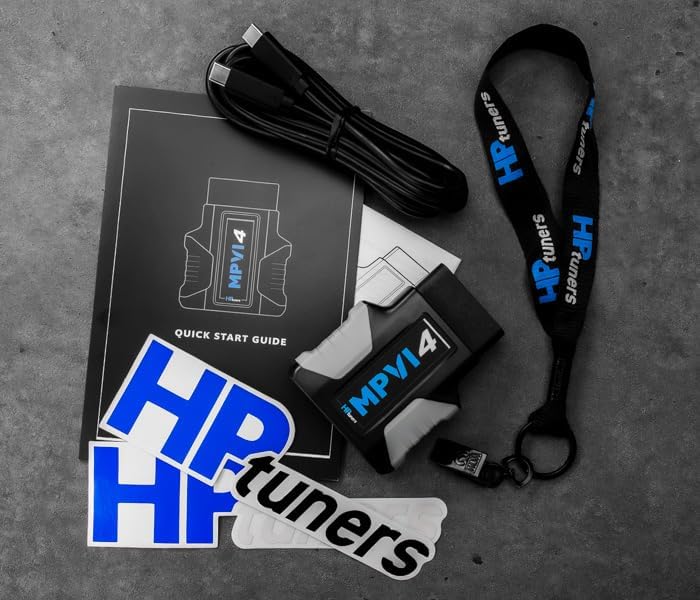
HP Tuners is the most widely used flash-tuning platform in the LS world, and for good reason. The MPVI3 (Multi-Protocol Vehicle Interface, version 3) is a physical interface device that plugs into your OBD-II port and communicates with the factory PCM (Powertrain Control Module — GM’s term for the engine/transmission computer). The VCM Suite software runs on your laptop and lets you read, edit, and write calibration files.
What it actually gives you on LS platforms: Per HP Tuners’ 2025 MPVI3 spec sheet, the interface supports virtually every Gen III and Gen IV LS PCM (that covers everything from the original 1997 LS1 through the LS3, L99, and LS9 used in C6/C7 platforms), plus Gen V LT-family engines. You can edit fuel tables, spark tables, MAF (Mass Air Flow sensor) calibrations, boost control on forced induction builds, rev limiters, speed limiters, and transmission shift points when running a 4L60E, 4L80E, or 6L90 behind the engine. For cam-swapped or supercharged LS builds in the 400–700whp range on factory-based harnesses, this is the tuning ecosystem most professional tuners have already invested in.
Credits system — understand this before you buy. HP Tuners runs on a “credits” model that confuses a lot of first-time buyers. You buy the MPVI3 hardware (street price approximately $369–$399 as of mid-2026), but reading or writing a PCM also consumes credits, which you purchase separately (typically $50 per 4 credits, and most common GM PCMs cost 2–8 credits to unlock). If you’re taking the car to a tuner who already owns HP Tuners, they’ll use their own license — you don’t need to buy the hardware yourself. If you want to own the platform for data logging and iterative self-tuning, budget accordingly. Dragzine’s 2023 comparison of HP Tuners vs. EFI Live notes that HP Tuners’ broader PCM coverage is its primary advantage over EFI Live for builders who work across multiple platforms.
Ceiling: HP Tuners works within what the factory ECU can physically process. Add a big enough cam, enough boost, and enough fuel demand, and you’ll hit firmware limitations the software can’t work around — particularly on older Gen III PCMs. The LS1/LS6 “T56” PCM, for example, has fuel injector scaling limits that can require PCM swaps before tuning will get you there. EngineLabs’ LS swap ECU shootout (Engine Labs Media, 2023) covers these ceilings in detail and recommends moving to a Gen IV–based PCM (like the E38 used in the LS3 Corvette) before attempting HP Tuners tuning on a high-horsepower cam-and-boost build.
Haltech Elite 2500: Full Control, Full Commitment
The Haltech Elite 2500 is a true standalone ECU — it replaces your factory computer entirely. Per Haltech USA’s 2024 Elite 2500 Technical Manual, the unit supports up to 8 cylinders with fully sequential fuel injection and ignition, onboard flex fuel logic, built-in boost control for up to two turbos or a single supercharger, traction control inputs, and an internal 3-axis G-sensor for launch control on drag builds. It communicates over CAN bus (Controller Area Network — an automotive data network standard) and supports both wideband oxygen sensors directly without an outboard controller.
For LS swaps into non-GM chassis or Coyote builds that have abandoned the factory harness entirely, this is where serious builders land. The Elite 2500’s plug-and-play harnesses for common LS variants (Gen III and IV) and Coyote Gen 1/2 engines (2011–2017 5.0L) reduce wiring complexity, though “plug-and-play” still means you’re commissioning a full base map and going through a proper dyno calibration session.
Real-world power results from published reports: Hot Rod Magazine’s 2024 Coyote swap tuning guide documents a Haltech Elite 2500-equipped 2015 Coyote (Gen 2, Ti-VCT) making 612whp on E85 with a Procharger D-1SC, comparing favorably to the same engine platform tuned on a recalibrated factory PCM, where cam timing authority was reportedly limited by factory firmware constraints. The Haltech unit allowed full independent control of the Coyote’s dual variable cam timing system — something that flash tuning on the factory ECU can access but with narrower adjustment windows.
The real cost: The Elite 2500 retails around $1,800–$2,200 depending on harness configuration as of mid-2026. Add a harness kit ($400–$900), a wideband controller if not integrated, and a tuner who works in Haltech’s NSP (Nexus Tuning Platform) software, and you’re looking at $3,000–$4,500 all-in before the dyno. That’s a meaningful premium over HP Tuners, and it requires a tuner with specific Haltech experience — not every shop has it.
Ford Performance Calibration Tool: The Coyote-Specific Shortcut
Ford Performance’s Calibration Tool (part number M-6017-A504V, per the 2025 Ford Performance Parts product bulletin) is the most platform-specific option here. It’s a Ford-supplied hardware/software combination designed exclusively for Ford Performance crate engines and certain factory Coyote applications, allowing calibration edits through a locked-down interface that works within Ford’s own calibration architecture.
What it unlocks: For Coyote crate engine builders (the Gen 3 5.0L Coyote crate engine, part number M-6007-M50C, being the primary target), the Calibration Tool allows MAF scaling, injector sizing, rev limit adjustment, and basic spark and fuel table edits. It does not give you the same depth of table access as HP Tuners running on a PCM with full credits unlocked. But for builders using a Gen 3 Coyote crate in a kit car, hot rod, or restomod where they’re starting from Ford’s published base calibration, it eliminates the chicken-and-egg problem of getting a factory Ford PCM licensed for a non-OEM application.
The tradeoff in plain terms: Ford Performance’s Calibration Tool is simpler and narrower by design. It won’t run your boosted build; it won’t manage a flex fuel sensor; it won’t talk to a Haltech traction control node. What it does is get a naturally aspirated or mildly modified Gen 3 Coyote running correctly in a custom install without requiring a professional tuner to spend four hours configuring a standalone ECU from scratch. For street rods, Coyote swaps into early Mustangs, and kit car builds, the reduced complexity is genuinely valuable.
By the Numbers: Quick Comparison
| Platform | Entry Cost (hardware) | Platform Target | Tuner Availability | Ceiling (whp) |
|---|---|---|---|---|
| HP Tuners MPVI3 | ~$370 + credits | LS1–LT5, Coyote Gen 1–3 | Very high | ~700whp (PCM-dependent) |
| Haltech Elite 2500 | ~$2,000 + harness | Any LS/Coyote variant | Moderate | 1,000whp+ |
| Ford Perf. Cal. Tool | ~$500 | Gen 3 Coyote crate only | Low (Ford dealer network) | ~550whp N/A |
Cost estimates based on mid-2026 distributor pricing. Tuner shop rates ($150–$250/hr dyno time) not included.
The Decision Rule: If X, Then Y
Here’s how to think about this without second-guessing yourself on the dyno table:
If your LS or Coyote is still on a factory or stock-replacement harness, and your power target is under 600whp: HP Tuners is the right tool. The tuner ecosystem is massive, base maps are widely available, and you’ll spend your money on dyno time and parts rather than wiring. The credits model is a minor annoyance, not a dealbreaker. Find a tuner who carries HP Tuners and has logged hours on your specific PCM variant before booking.
If you’re doing a full engine swap into a non-donor chassis, building above 600whp, or running flex fuel with custom sensor inputs the factory ECU doesn’t support: Haltech Elite 2500 is the platform to spec. The upfront cost is real, but you’re buying capability you’ll actually use, and you’re not fighting factory firmware limitations at the worst possible moment — on the dyno at 25 psi.
If you’re building around a Ford Performance Gen 3 Coyote crate and want a simpler, Ford-supported calibration path for a naturally aspirated or lightly modified street build: The Ford Performance Calibration Tool is a legitimate shortcut that removes complexity without removing reliability. Don’t try to force it onto a boosted application — that’s not what it was designed for, and the table access isn’t there.
One last thing worth saying plainly: the best ECU in the world won’t save a bad base tune, and the most capable standalone won’t compensate for an inexperienced tuner. Across aggregated builder reports on EngineLabs and Dragzine, the consistent pattern is that platform choice matters less than tuner quality at equivalent power levels. Budget for dyno time the same way you budget for hardware — it’s not optional overhead, it’s part of the build.