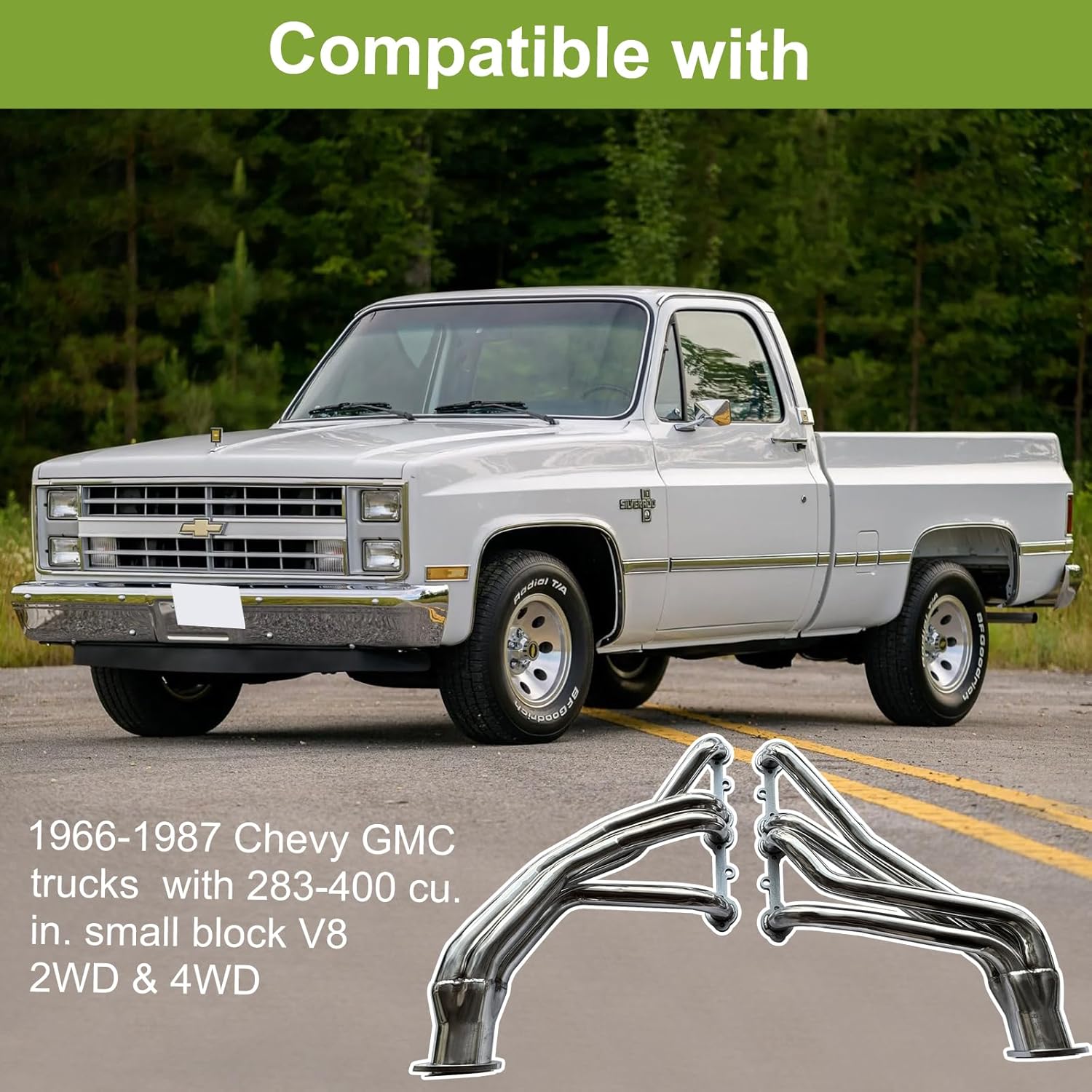
If you’ve ever heard a stock small-block Chevy coughing its exhaust through factory iron manifolds — those cast-iron lumps that were designed around smog equipment, steering clearance, and manufacturing cost, not airflow — you already understand the appeal of headers. Headers (bolt-on exhaust manifold replacements made from individual steel tubes that merge into a collector) are one of the oldest, most proven power upgrades in the small-block world. The core idea is simple: instead of four cylinders sharing a cramped common chamber before the exhaust exits, each cylinder gets its own tube sized and routed to maximize scavenging — the way spent exhaust gases exiting one cylinder can actually pull fresh mixture into the next firing cylinder, a free-horsepower phenomenon dictated entirely by tube length and diameter. On a stock or mildly built 350, headers routinely add 15–35 rear-wheel horsepower with no other changes. On a built engine, they’re not optional — they’re the difference between the engine breathing or suffocating.
But here’s what the marketing copy never explains: the “right” header for your platform isn’t just about tube diameter or collector size. It’s about which swap the prior owner did, whether your truck has a factory steering box or a rack conversion, whether your Camaro is a first-gen or second-gen, and what coating you’re willing to maintain over the next 50,000 miles. This guide cuts through the noise with platform-specific fitment reality, real dyno context, and clear decision rules so you can stop reading and start ordering.
Tube Diameter: The Single Most Misunderstood Decision
The default instinct is to go bigger — 1-7/8” primary tubes instead of 1-5/8”, because more tube equals more power, right? The reality is more nuanced and directly tied to your engine’s rpm powerband.
Primary tube diameter affects exhaust gas velocity. Smaller tubes maintain higher velocity at lower engine speeds, which improves low-rpm scavenging and keeps torque in the street-driveable range. Larger tubes flow more at peak rpm but let velocity drop at lower speeds, pushing the powerband up toward the top of the rev range. On a street-driven truck with a mild 350 or 383 stroker and a hydraulic roller camshaft peaking around 5,500–6,000 rpm, 1-5/8” primaries will outperform 1-3/4” in the rpm range you actually use. Engine Labs’ dyno analysis feature on header tube diameter confirms that the peak-power gains from oversized primaries come at the cost of sub-4,500-rpm torque — exactly the range a street truck lives in.
For Camaros and Chevelles running higher-revving combinations — think a solid roller, 400+ cubic inches, or a blower application making peak power above 6,500 rpm — the calculus shifts. Hooker SuperComp 1-3/4” headers in their technical documentation rate their full-length design for applications in the 450–600+ horsepower range specifically because sustained peak-power output rewards the larger tube.
By the Numbers: Tube Diameter vs. Application
| Primary Tube | Best For | Peak RPM Window | Torque Below 4,500 |
|---|---|---|---|
| 1-5/8” | Stock–383 street, trucks, mild cam | 4,500–6,000 | Strong |
| 1-3/4” | 400+ ci, hot cam, moderate boost | 5,500–6,800 | Moderate |
| 1-7/8” | Race only, 550+ hp, high-rpm blower | 6,500–8,000+ | Weak |
Collector diameter follows the same rule: 3” is appropriate for most 1-5/8” primary setups, while 3-1/2” collectors pair with 1-3/4” and larger primaries. Mismatching a 3-1/2” collector to a 1-5/8” primary set kills scavenging at low rpm and gains you nothing measurable on the dyno — Hot Rod Magazine’s SBC header feature makes this point explicitly when walking through collector selection for street builds.
Platform Clearance: Where Most Installs Go Wrong
This is the section the marketing photos don’t show you. Real-world fitment on classic platforms is where builds stall, return shipments happen, and installers reach for the die grinder.
First-Gen Camaro (1967–1969): The first-gen is generally the most header-friendly of the classic GM platforms, but it still bites builders who don’t check steering shaft routing. The factory rag joint and steering column run directly through the driver’s side primary tubes on most shorty and mid-length designs. Full-length headers require a ceramic-coated clearance design or the factory column swap to a tilt column or aftermarket rack. Hedman Hedders’ 2024 fitment catalog specifically notes that their 68000-series full-length headers for 67–69 Camaros are not compatible with factory manual steering boxes without modification to the intermediate shaft. If you’re running a CPP or TCP rack-and-pinion conversion, clearance opens up significantly — confirm with your rack manufacturer before ordering.
Second-Gen Camaro (1970–1981): The second-gen tightens everything up. The wider engine bay sounds like good news but the subframe rails, steering box location, and frame kick move closer to the exhaust ports. Doug’s Headers’ classic Camaro fitment notes document that their D-356 series requires header wrap or heat shielding near the steering box on 70–73 applications with the original Saginaw box. Owners on second-gens consistently report that shorty headers are the lowest-drama install, but leave 10–20 wheel horsepower on the table compared to a properly clearanced full-length set.
Chevelles and A-Body (1964–1972): The A-body platform is arguably the sweetest for full-length headers because the framerails sit lower relative to the engine centerline, giving more tube routing room. The complication here is chassis variation by year: 1964–1967 A-bodies use a different subframe geometry than 1968–1972 models, and this affects collector routing and ground clearance. Summit Racing Equipment’s SBC header buyer’s guide specifically flags that headers listed for “A-body” generically may not clear the 1964–1967 front subframe correctly — confirm part numbers list your specific year range. The 1970–1972 Chevelle SS with factory power steering adds a hydraulic line routing conflict on the driver’s side that builders routinely address with a braided line reroute, not a different header choice.
Classic C10/C20 Trucks (1967–1972): Truck fitment is its own universe. The SBC truck swap world has fragmented into so many steering configurations — factory recirculating ball, Ididit column with factory box, Borgeson conversion, full rack swap — that no single header fits all combinations. Hedman’s truck-specific catalog separates fitment by steering type, not just year. The most common conflict is driver’s-side primary tubes hitting the Borgeson steering shaft conversion, which runs a different trajectory than the factory shaft. Owners consistently report that calling Hedman or Doug’s tech lines before ordering saves a return shipment; both companies maintain year/make/trim fitment matrices that their websites don’t always surface clearly.
Coating Reality: What Actually Survives Five Years on a Street Car
Three coating options dominate the market: raw steel (typically uncoated or lightly primed), ceramic-coated, and stainless steel. The choice matters more than most buyers realize at point of purchase.
Raw or mild steel is the cheapest entry point and is fine for race cars that get torn down annually or engines that will be wrapped in header tape. On a street-driven classic that sees rain, road spray, and temperature cycling, raw steel headers typically show surface rust within one season and significant corrosion within two to three years without aggressive maintenance. Summit Racing’s buyer’s guide notes that raw steel headers are typically the right call only if you’re planning to wrap them yourself or if cost is the absolute priority and you accept the maintenance trade-off.
Ceramic coating is the sweet spot for 90% of classic builds. Manufacturers like Hooker and Hedman apply a porcelain-infused thermal barrier that reflects radiant heat away from the engine bay (reducing underhood temps, which matters for fuel system components and wiring on classics with minimal factory heat shielding), reduces surface corrosion dramatically, and survives the thermal cycling of street use without the flaking issues that older aluminum-paint coatings developed. Hooker’s SuperComp documentation rates their ceramic coating to 1,400°F continuous surface temperature. Owners of ceramic-coated headers on street-driven Camaros and C10s consistently report the coating looking presentable after three to five years of regular use with no special maintenance beyond occasional heat cycling at startup.
Stainless steel headers — 304-grade is the standard — are the premium option and the right choice for builders who want a zero-maintenance finish that won’t surface-rust regardless of storage conditions. The trade-off is cost (typically 40–70% more than comparable ceramic-coated steel) and weldability if you need to modify collector length or add an O2 sensor bung. For a clean show-quality build or a car that gets parked wet, stainless is worth the premium. For a track-day car that gets header wrap and a heat blanket anyway, it’s overkill.
Shorty vs. Mid-Length vs. Full-Length: The Honest Trade-off
Shorty headers (primaries merge into a collector just below the port exits, typically 10–14” long) are the clearance king. They fit virtually every classic platform with minimal modification, often accept factory heat shields, and are genuinely compatible with smog equipment for states that require inspections on pre-1976 vehicles. The power trade-off is real: dyno data cited in Hot Rod Magazine’s SBC header feature shows shorty headers adding 10–18 rwhp over factory manifolds on a stock 350, versus 20–35 rwhp for a properly fitted full-length set on the same engine. If your Camaro or truck has a difficult steering configuration and you’re not ready to do the column work, shorties are not a compromise — they’re a logical choice with a known power ceiling.
Mid-length headers split the difference with primaries typically 20–26” long. They clear better than full-length on most platforms, get closer to the full-length power number, and are the most practical choice for a street-driven C10 that isn’t getting a steering conversion. Doug’s Headers’ fitment notes for their mid-length truck series show them clearing factory Borgeson conversions on 67–72 C10s with less than 1/2” of tube clearance on the driver’s side — workable, but worth verifying with a heat shield or ceramic coating at that point of contact.
Full-length headers are the only choice for serious power applications above 450 hp or any build using a cam that benefits from tuned primary length. They require the most installation work, the most clearance verification, and often a steering or motor mount modification on tight platforms — but they’re the only header that lets the engine fully breathe.
The Decision Rule
If your build is a street-driven truck or car with factory steering geometry and you’re under 400 hp: start with mid-length 1-5/8” ceramic-coated headers and verify fitment by calling the manufacturer’s tech line with your specific year, trim, and steering configuration.
If you’re over 400 hp, running a high-lift cam, or have already done a steering conversion that opens up clearance: full-length 1-3/4” ceramic or stainless headers are the correct call — budget the extra time for fitment verification and collector angle work.
If you’re in a state with smog inspection requirements on your classic: confirm CARB EO status before ordering any header. Most classic-truck and Camaro headers for pre-1976 vehicles are emissions-exempt in California under the pre-1976 cutoff, but verify with CARB’s online EO database — the California Air Resources Board maintains a searchable exemption order list — before assuming your application qualifies.
The header market for SBC classics is deep and well-supported. The builders who get this right the first time are the ones who call tech support, confirm fitment by year and steering type, and match tube diameter to their actual rpm powerband — not the powerband they’re planning to build someday.