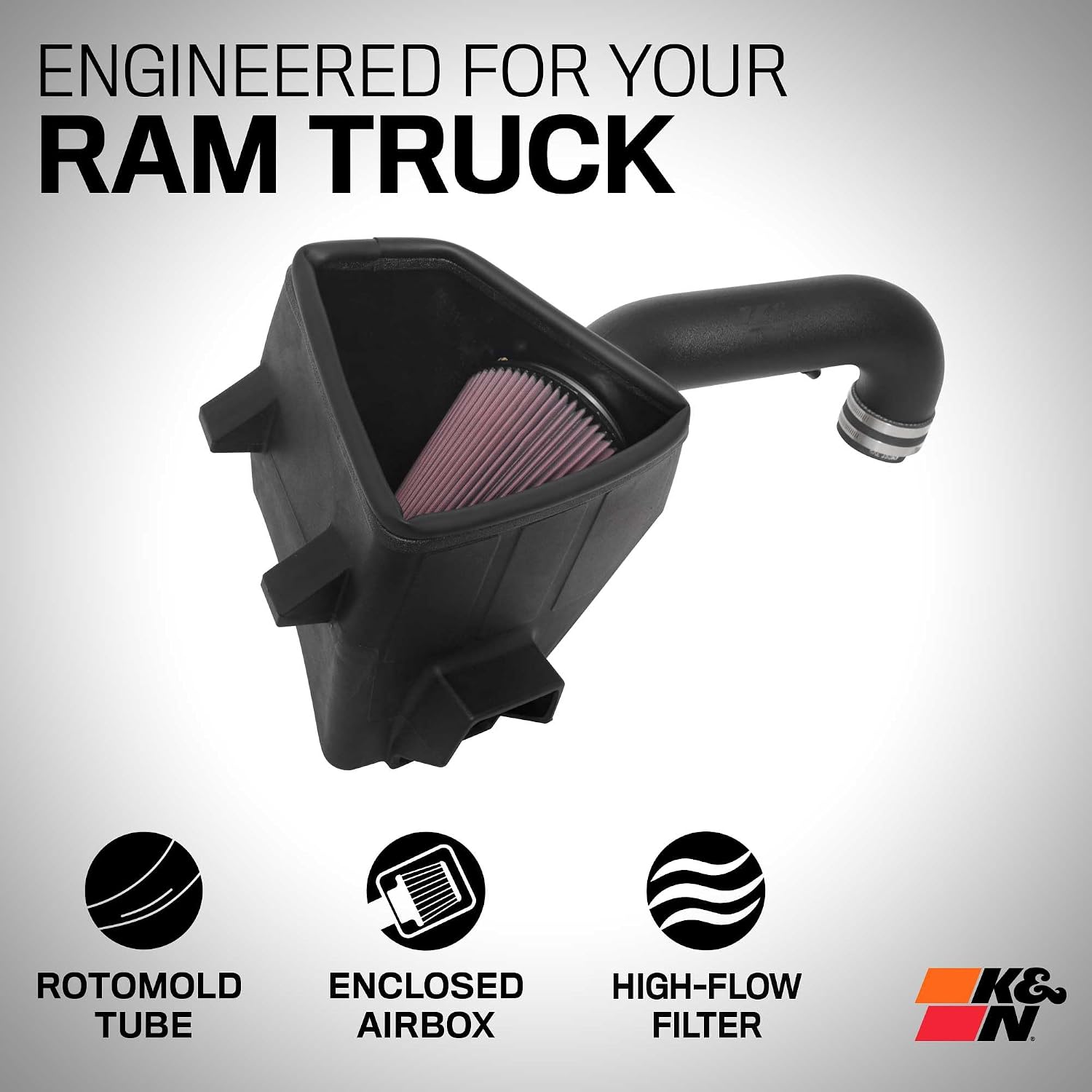
A cold air intake is exactly what the name says: a replacement for the factory airbox designed to feed your engine colder, denser air from outside the engine bay rather than pulling in hot underhood air. Denser air carries more oxygen per cubic foot, and more oxygen means the engine can burn more fuel and — in theory — make more power. That’s the engineering premise. The practical reality is more nuanced: on a lightly modified RAM 1500 with a 5.7L HEMI (Chrysler’s high-output V8, pronounced like the Greek letter — it refers to the hemispherical combustion chamber shape), you might see 10–18 wheel horsepower on a dyno. On a 6.7L Cummins diesel (RAM 2500/3500’s turbocharged inline-six), the story is completely different because that turbocharger rewrites the math. This guide breaks down what the dyno numbers actually say, which kits fit which build years without headaches, and the one acoustic problem nobody talks about enough until they’re living with it daily.
Why the HEMI and Cummins Respond Differently to Intake Upgrades
Before you drop $400–$600 on a CAI kit, you need to understand the fundamental difference in how a naturally aspirated engine and a turbocharged diesel respond to intake restriction changes.
On the 5.7L and 6.4L HEMI (found in the RAM 1500 and 2500 respectively), the engine is drinking air directly — every cubic foot per minute the intake flows is air the engine either gets or doesn’t get. The factory airbox on third-generation and fourth-generation RAM trucks is genuinely restrictive, particularly in models from 2009–2018 where the stock intake path uses a convoluted routing to suppress induction noise. Hot Rod Magazine’s overview of intake restriction testing on pushrod V8s notes that factory boxes often show 1.5–2.5 inches of water column of restriction under wide-open throttle — meaningful for a performance application even if invisible in daily driving. A well-designed CAI that shortens the path, uses a high-flow conical filter (a cone-shaped oiled or dry cotton gauze filter rather than a flat panel), and sources air from in front of the radiator support can legitimately cut that restriction in half.
On the 6.7L Cummins, you have a turbocharger sitting between the intake and the engine. The turbocharger’s compressor wheel is the dominant restriction — the factory intake simply needs to not choke the turbo’s ability to pull air. Engine Labs’ restriction testing data on turbocharged platforms consistently shows that intake gains are compressor-inlet pressure improvements, not direct airflow gains. That doesn’t mean a Cummins intake is useless — aFe Power’s Stage-2 Pro Dry S dyno summary for the 2019–2024 RAM 2500 6.7L Cummins documents 18–26 wheel horsepower and 40–55 lb-ft of torque improvement, but those gains depend heavily on whether the turbo is already boost-limited by the stock map. On a tuned Cummins making 500+ lb-ft, a less-restrictive inlet lets the turbo spool faster, which shows up as earlier torque delivery rather than peak numbers.
Bottom line: HEMI gains are real but modest at stock boost/fueling. Cummins gains are turbo-dependent and compound dramatically when paired with an EGR delete or tuned boost table.
Fitment Matrix: What Actually Bolts On by Year and Trim
This is where most buyers get burned. RAM changed its intake architecture across three distinct generations, and parts that fit a 2014 RAM 1500 Classic may require modification — or simply won’t seal — on a 2019 RAM 1500 DT-generation truck with the new 5.7L eTorque mild-hybrid system.
RAM 1500 5.7L HEMI Fitment Tiers:
| Generation | Years | Notes |
|---|---|---|
| DS (3rd gen) | 2009–2018 | Most universal fitment; widest kit selection |
| DS Classic | 2019–2022 | Shares DS architecture; verify MAF sensor diameter (90mm vs 87mm) |
| DT (5th gen) | 2019–2024 | eTorque trucks require MAF relocation; confirm before ordering |
| DT TRX | 2021–2024 | Supercharged 6.2L — completely different kit; DO NOT use 5.7L part numbers |
K&N Engineering’s published dyno test for their 57-1535 kit — their primary 5.7L HEMI application — shows 17.06 hp and 16.43 lb-ft gain at the wheels on a 2019 DS Classic. K&N’s fitment note explicitly excludes eTorque-equipped DT-generation trucks because the mild-hybrid belt-starter-generator repositions the valley cover and changes underhood clearances. If you’re ordering for a 2019 or newer DT-gen 1500, check the box for “eTorque” on K&N’s application guide — the fitment exclusion is clearly listed in their online catalog notes.
RAM 2500/3500 6.7L Cummins Fitment Tiers:
The 6.7L Cummins saw three distinct emissions configurations that directly affect intake fitment:
- 2007.5–2012: No DPF/DEF. Straightforward intake routing. aFe’s Momentum HD and Takeda Stage-2 kits fit without relocation.
- 2013–2018: DPF + DEF equipped. EGR cooler routing can interfere with larger intake tubes — verify clearance on aFe’s fitment notes or contact Mishimoto’s tech line directly.
- 2019–2024: Stage-5 emissions (6th-gen truck). New air filter housing location. Only kits explicitly listed for 2019+ will clear the relocated battery tray on crew cab configurations.
Owners of 2019–2024 Cummins trucks report on aggregated forum threads that running a 2018-spec intake kit requires cutting the factory resonator box bracket — possible, but not a clean install. aFe Power’s product documentation for the 2019–2024 application includes that bracket modification as an optional step, which is honest of them, but it should be a hard “check fitment first” flag.
Trims that DO NOT fit any standard RAM 1500 CAI kit: 2021–2024 TRX (6.2L supercharged), any RAM 1500 EcoDiesel (3.0L VM Motori — separate application category entirely), and 2019+ eTorque trucks without the eTorque-specific kit variant.
Drone Risk: The Problem Nobody Fully Explains at the Point of Sale
Induction drone is the low-frequency cabin resonance — that low, oscillating moan at certain RPMs — that appears after an intake swap. It’s not the throaty induction roar you hear in short videos. Drone is what you live with at 65–75 mph on the highway, typically between 1,400–1,900 RPM on a HEMI, and it ranges from “barely noticeable” to “genuinely fatiguing on long drives.”
Here’s the physics: the factory airbox is tuned not just for airflow but as a Helmholtz resonator — a sealed volume that cancels specific sound frequencies. When you remove it and replace it with an open-element cone filter in a heat shield, you eliminate that tuning. The intake tract becomes a direct acoustic path into the cabin. Car and Driver’s long-term update coverage on RAM exhaust and intake combinations notes that drone severity scales with cab type — crew cabs with longer wheelbases and more shared body panels resonate more than quad cabs.
How to mitigate it:
- Enclosed vs. open-element kits: Kits from S&B Filters and aFe that include a full sealed airbox (same filter element, but the cone sits inside a box that seals to the fender) dramatically reduce drone versus fully open kits like Volant or K&N’s “open element” configurations. If you’re in a work truck that sees highway miles, pay the extra $50–$100 for the enclosed version.
- Resonator retention: Some kits include a small resonator plug. Owners consistently report that keeping the resonator in line reduces the 1,600 RPM resonance peak without meaningfully affecting flow.
- Tune interaction: On a standalone-tuned HEMI where the MAF scaling has been adjusted, the drone profile often shifts slightly because cam phasing and throttle behavior at cruise change. If you’re planning a tune (HP Tuners, Lund Racing) anyway, do the intake first so the tuner can address the resonance RPM range in the torque management table.
The Dyno Reality Check
By the numbers — peak wheel gains reported across manufacturer dyno sheets and owner-submitted dyno pulls aggregated by platform:
- 5.7L HEMI (DS-gen RAM 1500, stock tune): 12–18 whp, 10–16 lb-ft — K&N Engineering published dyno, aFe Power product documentation
- 6.4L HEMI (RAM 2500/Power Wagon, stock tune): 8–14 whp — gains are smaller because the 6.4’s factory intake is already less restrictive
- 6.7L Cummins (stock tune, 2019–2024): 18–26 whp, 40–55 lb-ft — aFe Power Stage-2 Pro Dry S documentation
- 6.7L Cummins (tuned, 500+ lb-ft baseline): compound gains possible; intake alone adds 10–15 whp but enables additional boost headroom worth another 30–50 whp via retune
Engine Labs’ intake restriction testing article is worth reading here — their conclusion on naturally aspirated engines is that intake gains are real but front-loaded: the first upgrade from stock to a quality CAI delivers most of the available airflow improvement. A second upgrade (larger throttle body, ported manifold) is where the diminishing returns curve flattens hard. For the HEMI specifically, don’t expect to stack intake kits or go from a $150 CAI to a $500 one and see proportionally more power — the filter and tube diameter, not the brand premium, drive the difference.
One calibration note for Cummins diesel owners: fuel economy claims in marketing materials for diesel CAI kits are almost entirely unverifiable in real-world conditions. Car and Driver’s RAM 2500 long-term reporting found negligible economy improvement attributable to intake alone outside controlled conditions. The power gains are real; the MPG claims should be discounted until you have your own before/after data.
The Decision Rule
If you’re building a stock or mildly modified RAM 1500 HEMI for street use and want the intake sound, real gains, and clean installation: get an enclosed-airbox kit from aFe or S&B for $350–$500 and pay for the drone-reducing design upfront. K&N’s open-element kits flow well and make the same peak numbers, but on crew cabs especially, owner reports consistently flag highway drone as the trade-off. Verify eTorque fitment before ordering if you’re on a 2019+ DT.
If you’re on a 6.7L Cummins and already have or are planning a tune, the intake is a near-mandatory pairing — the tuner needs the intake to maximize boost table calibration anyway, and the combined power gains justify the spend. Budget the intake into your tune package rather than treating it as a standalone purchase.
If you’re on a 6.4L HEMI or a stock-power Cummins with no tune planned, run the numbers honestly: 8–14 whp on a truck that probably weighs 5,400–6,200 lbs moves the needle less than it will on a 3,400-lb sports car. The intake is still a worthwhile modification — it’s just the first step in a stack, not the whole strategy.