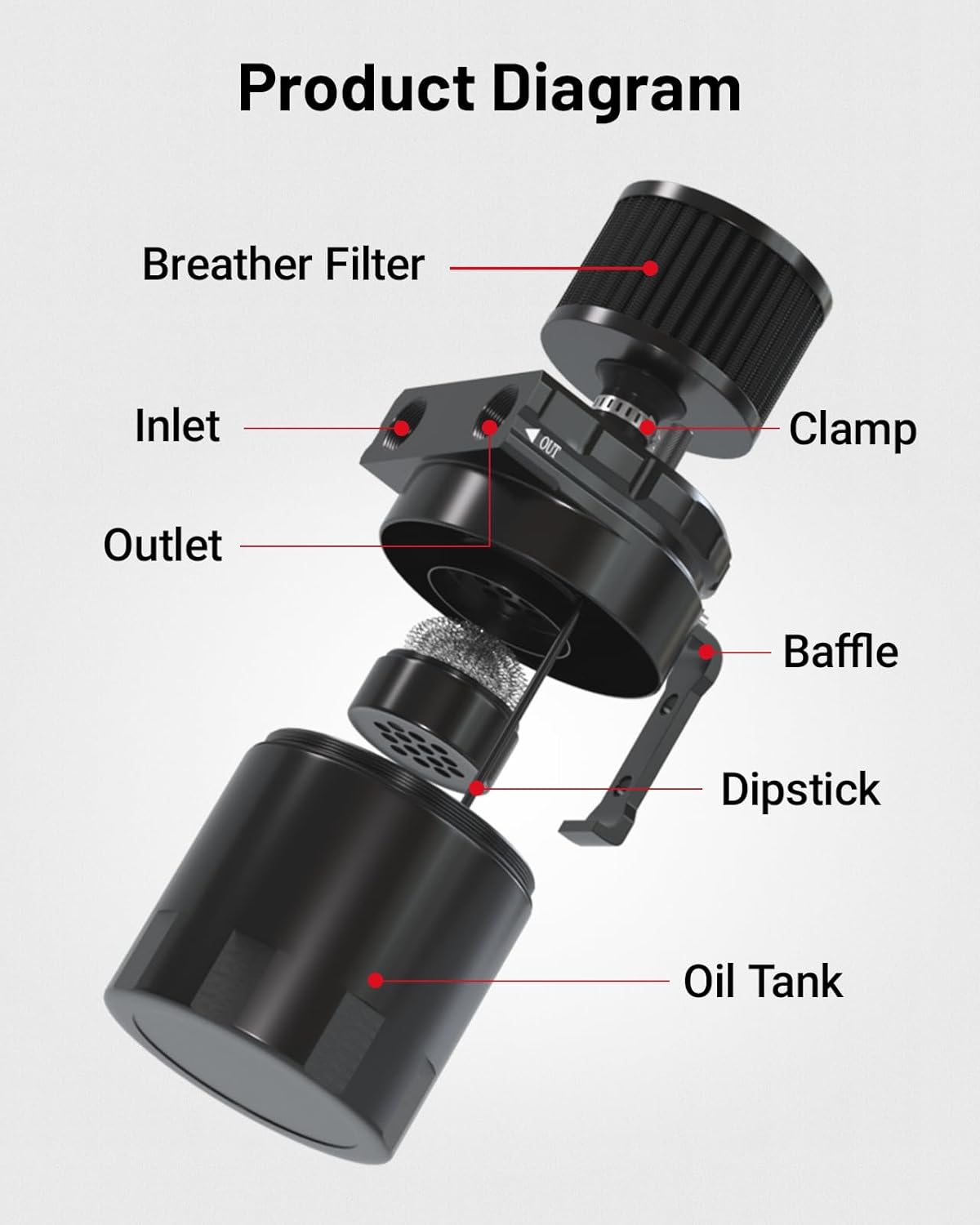
Every time your engine runs, combustion gases slip past the piston rings and into the crankcase — the sealed chamber below your pistons. Your factory PCV (Positive Crankcase Ventilation) system is designed to deal with this by venting those gases back into the intake manifold to be burned off, rather than releasing raw hydrocarbons into the atmosphere. That sounds responsible and clean, but there’s a catch: those gases carry fine mist particles of oil with them. Under boost on a turbocharged engine — or simply on any high-mileage motor with worn rings — the volume of oily vapor going back through your intake system increases dramatically. The result is a slow, relentless coating of carbon and oil baked onto your intake valves, inside your intercooler piping, and across your throttle body. An oil catch can is a small canister plumbed inline between the crankcase vent and the intake — it traps that oily mist before it ever touches your valves. This guide explains who actually needs one, what the hardware differences mean in real-world performance, and how to match a catch can to your specific build.
| EDITOR'S PICK[EVIL ENERGY Oil Catch Can](https://www.amazon.com/dp/B0DPPS3WWP?tag=greenflower20-20) | Mid-tier[EVIL ENERGY Oil Catch Can](https://www.amazon.com/dp/B0DPPS3WWP?tag=greenflower20-20) | Budget pick[EVIL ENERGY Oil Catch Can](https://www.amazon.com/dp/B0DPP6LY44?tag=greenflower20-20) | |
|---|---|---|---|
| Breather Filter | ✓ | ✓ | ✗ |
| Hose Type | CPE | NBR | NBR |
| Fittings Included | ✓ | — | — |
| Price | $47.99 | $35.29 | $34.29 |
| See on Amazon → | See on Amazon → | See on Amazon → |
Why Turbocharged and Direct-Injection Engines Have It Worse
On a port-injected engine — a traditional setup where fuel injectors spray directly into the intake port — fuel wash provides a built-in cleaning effect that partly offsets carbon buildup on intake valves. It’s not perfect, but it helps. Direct injection (DI) engines — found on platforms like the Ford 5.0 Coyote Gen 3, the GM LT1/LT4 family, the EcoBoost 2.3L/3.5L, and most modern turbocharged four-cylinders — spray fuel directly into the combustion chamber, bypassing the intake port entirely. That means zero fuel wash on the back of the intake valves. Whatever oily vapor the PCV system deposits there just stays there, bakes on, and accumulates cycle after cycle.
Engine Labs documented in their coverage of direct injection carbon buildup that DI engines can accumulate enough valve deposits to meaningfully restrict airflow in as little as 30,000–50,000 miles under normal driving conditions — and that timeline shortens dramatically under boost. SAE International’s technical paper 2018-01-0363 on turbocharged engine blow-by quantified that boost pressure increases crankcase pressure differentials significantly, pushing higher volumes of oil mist through PCV passages than naturally aspirated applications. If you’re running a turbo on an LT1, a Coyote swap with a ProCharger, or a built 2.7 EcoBoost, you’re accelerating the deposit timeline with every mile driven on a boost tune.
High-mileage engines compound the problem for a different reason: ring seal. As piston rings wear, more combustion gas slips into the crankcase — this is called blow-by. More blow-by means more crankcase pressure, which means the PCV system is working harder and routing more oil mist back through your intake. An engine with 120,000 miles doesn’t need to be “worn out” to show measurably increased blow-by; even moderate ring wear changes the equation.
What to Look For in an Oil Catch Can: Four Variables That Actually Matter
Not every catch can is the same, and the difference between a budget unit and a quality piece isn’t just brand markup — it’s internal design.
1. Filtration Media vs. Baffle-Only Design
The cheapest catch cans are simple chambers with baffles — physical plates that force the airflow to change direction, causing heavier oil droplets to fall out of suspension. This works reasonably well at lower flow rates. Quality units add internal filtration media (typically metal mesh or foam) that captures finer particles the baffles miss. Under heavy boost, where flow velocities are higher and droplets are finer, media-style cans catch meaningfully more. Owners across build threads on platforms like the 5th-gen Camaro SS and F-150 EcoBoost consistently report noticeably dirtier catch cans after track days versus street use — which correlates directly with increased PCV flow under boost load.
2. Reservoir Volume
This is the capacity of the can itself — how much oil it can hold before you drain it. On a tight street schedule (say, every 5,000-mile oil change interval), a 150–200mL reservoir is typically adequate for a stock or mildly modified engine. For a heavily boosted build, turbocharged diesel (6.7 Cummins owners in particular), or any high-mileage engine with elevated blow-by, a 300mL or larger reservoir keeps drain intervals practical. Running a catch can that fills up between service intervals is a maintenance headache — and an overfull can risks passing liquid oil downstream into your intake, which is the exact problem you’re trying to prevent.
3. Dual-Circuit vs. Single-Circuit Design
Many engines run two PCV circuits: a crankcase vent line (typically from the valve cover) and a breather line (often routed to a port before the throttle body). A single catch can plumbed only on one circuit leaves the other venting freely. Dual-circuit catch cans, or running two separate cans, addresses both return paths. Hot Rod Magazine’s technical coverage of PCV upgrades for performance engines specifically calls out that running only a single-circuit can on a boosted LS or LT application leaves the secondary breather as a continued contamination source. On dedicated track builds, this matters.
4. Drain Mechanism
Easy serviceability matters more than it sounds. A catch can you need to fully disconnect from the plumbing to drain will get ignored, especially if it’s buried in the engine bay. Quality units include a bottom petcock valve or a threaded plug accessible without tools. If the can is in a tight location behind the intake manifold on a transverse four-cylinder, this detail becomes a real functional issue.
Platform-Specific Notes: Where to Focus Your Research
Ford 5.0 Coyote (2011–present): The Gen 3 Coyote (2018+) switched to DI-only injection on both banks, making catch can installation essentially mandatory for any boosted build or high-mileage application. Earlier Gen 2 Coyotes used port injection in parallel, which provides some self-cleaning, but boosted setups still benefit. Fitment note: factory PCV routing changed between 2011–2014 (Boss 302 and early GT) and 2018+ GT/Bullitt/Mach 1 — confirm your specific routing before purchasing a kit marketed as a “Coyote” fit.
GM LT1/LT4 (2014–present C7/C8 Corvette, 5th/6th-gen Camaro SS/ZL1): Direct injection only on the LT1; the LT4 adds port injection as a secondary circuit for cleaning, but the crankcase venting remains an issue on hard track use. OnAllCylinders notes in their catch can overview that the LT platform’s crankcase pressure behavior under sustained high-rpm use is a documented concern among autocross and road-course competitors.
Ford 2.7 and 3.5 EcoBoost: Twin-turbocharged, direct injection, and increasingly common in performance builds. Popular Mechanics coverage of catch can applications cites the EcoBoost family as one of the highest-priority platforms for catch can installation given the combination of DI architecture and twin turbos driving elevated crankcase pressure. Both the F-150 and the Edge ST application share similar PCV routing challenges; aftermarket kits from Mishimoto, Moroso, and Billet Technology address both.
6.7 Cummins (2007.5–present): Turbocharged diesel with known blow-by characteristics as mileage increases, especially on trucks with modified injection tables running elevated boost pressure. The 6.7 community has long used catch cans as preventive maintenance — owners report emptying cans of 50–100mL of oily residue per oil change interval on trucks with 100,000+ miles, a volume that would otherwise coat the EGR cooler and intake manifold.
LS Truck Engines (Gen III/IV, 4.8/5.3/6.0): Port injected, so the immediate DI-related deposit problem doesn’t apply. However, high-mileage 5.3L trucks with AFM (Active Fuel Management) systems are known for elevated blow-by due to lifter and ring wear patterns associated with the AFM delete. On boosted LS builds, catch can installation is standard practice.
By the Numbers
| Platform | DI Architecture | Boost Present | Catch Can Priority |
|---|---|---|---|
| Coyote Gen 3 (2018+) | Yes | No (stock) | High |
| Coyote Gen 3 + Forced Induction | Yes | Yes | Critical |
| LT1 (stock) | Yes | No | High |
| 2.7/3.5 EcoBoost | Yes | Yes (stock) | Critical |
| 6.7 Cummins 100k+ mi | No | Yes (stock) | High |
| LS 5.3 (stock, low mileage) | No | No | Low–Moderate |
What It Costs and What to Avoid
Entry-level catch cans from generic import brands run $25–$60 and typically use baffle-only designs with no drain valve and inconsistent fitting sizes. These can work as a temporary solution, but owners in long-term build reviews report the cheaper cans often use brittle fittings and begin weeping at connection points within a year of boost exposure. The manufacturing tolerance on internal baffles is also inconsistent — some units pass a surprising percentage of oil mist straight through.
Mid-range options from brands like Mishimoto, Moroso, and Billet Technology run $80–$180 for platform-specific kits that include the correct AN fittings, bracket hardware, and clear reservoir tubes for easy inspection. At this price point, you’re getting an internal filter element and a drain petcock as standard features — both worth the delta.
For dedicated track builds where the catch can is part of a full PCV overhaul (adding a vent-to-atmosphere option, a check valve, and a larger breather filter), budget $200–$350 for a complete system. Moroso’s billet catch cans and Mishimoto’s universal kits with filter media are consistently cited by owners running these configurations on Coyote and LT platform builds.
What to avoid: Un-branded universal cans with compression fittings only (no AN or barb), any unit without a drain mechanism, and kits that don’t specify fitment by year/make/trim. A catch can plumbed with fittings that don’t match your vacuum line diameter creates boost leaks — which is a worse problem than the one you’re solving.
CARB note for California readers: Oil catch cans that vent crankcase gases to atmosphere (open-system designs) are not CARB-legal for street use. Closed-loop systems that route filtered air back into the intake maintain CARB compliance. Confirm CARB EO status with the manufacturer before purchasing if you’re emissions-testing in California.
The Decision Rule
If you’re running a turbocharged direct-injection engine — EcoBoost, LT4, boosted Coyote Gen 3, turbo 4-cylinder on any platform — a catch can with filter media and a drain valve is a required maintenance component, not an optional upgrade. The cost of a quality unit at $100–$180 is trivial relative to the cost of walnut blasting intake valves (typically $400–$700 in labor) or rebuilding an intercooler coated with baked-on oil residue.
If you’re on a naturally aspirated DI platform (stock LT1, stock Gen 3 Coyote) with under 60,000 miles, a catch can is a smart preventive investment, especially if you track the car. If you’re on a port-injected engine under 80,000 miles with no forced induction, you can defer this — prioritize other supporting mods first.
For high-mileage turbocharged diesel applications, treat the catch can as a service item with every oil change: drain it, inspect the volume, and track the trend. Increasing fill rate between intervals is an early indicator of ring wear or a boost leak worth investigating.
The hardware is cheap. The valve deposits are not.