LS Truck Cold Air Intakes: Dyno Numbers, Fitment Traps, and Which Kits Actually Deliver
If you own a truck powered by GM’s LS or Vortec engine family — that’s the 4.8L, 5.3L, or 6.0L V8 found in Silverados, Sierras, Suburbans, Tahoes, and Yukons from roughly 1999 through the mid-2010s — you’ve probably seen cold air intake (CAI) kits advertised with big horsepower claims on the box. A cold air intake replaces the factory airbox and plastic tubing with a wider, less-restrictive pipe that pulls air from a cooler location, usually down near the fender well. Cooler, denser air burns more efficiently and can free up power the engine is already capable of making but can’t access because the stock system is choked down. The theory is solid. The execution varies wildly by brand. This guide cuts through the marketing, shows you what dyno sheets actually say, flags the fitment traps that’ll cost you time and money, and gives you a clear decision framework for your specific platform and goals.
What the Dyno Actually Shows — and What It Doesn’t
Let’s start with the number everyone wants: how much horsepower does a cold air intake add on an LS truck?
The honest answer is a range, and it matters a lot where you land in that range.
By the Numbers — Published Dyno Gains on Common LS Truck Platforms:
| Platform | Engine | Kit | Published Gain (RWHP) |
|---|---|---|---|
| 2000–2006 Silverado 1500 | 5.3L (LM7) | K&N 57-3042 | +13–17 whp |
| 2007–2013 Silverado 1500 | 5.3L (LC9/LMG) | Airaid 201-249 | +12–18 whp |
| 2001–2006 Silverado HD | 6.0L (LQ4) | Corsa CAI system | +15–20 whp |
| 1999–2006 Sierra/Silverado | 4.8L (LR4) | Spectre 9903 | +8–12 whp |
Sources: Airaid Performance Products dyno sheet for the 201-249 kit; K&N Engineering published dyno data for the 57-3042; Corsa Performance intake dyno summary; Spectre Performance 9903 published specifications.
A few things jump out. First, the 4.8L responds the least — it’s the most airflow-limited engine in the family by design, and the factory intake isn’t the primary bottleneck. Second, the 6.0L LQ4 in HD applications consistently shows the biggest returns because it has the displacement and cam timing to take real advantage of improved flow. Third, every single one of those numbers assumes a stock tune. If you’re already running a tune — or you add a tune after the intake — you can pick up another 10–15 whp on top of those figures, because a tuner can lean out the A/F ratio and adjust timing to actually exploit the additional airflow. Without a retune, the PCM’s closed-loop fueling will partially compensate and you’ll leave gains on the table.
Hot Rod Magazine’s feature “How Much Power Does a Cold Air Intake Really Add?” (published in their online archive) made exactly this point: bolt-on-only intake gains average 10–20 horsepower on naturally aspirated V8 platforms, but those numbers grow meaningfully when combined with a proper tune and supporting mods like a throttle body upgrade or long-tube headers.
Engine Labs’ LS engine induction overview reinforces the ceiling: the stock LS truck throttle body (78mm on most 5.3L applications through 2013) becomes the limiting factor once airflow upstream improves. If you’re already planning a tune, budget for a 90mm or 102mm throttle body at the same time and you’ll see the intake investment pay off more fully.
Fitment Traps That’ll Cost You a Saturday
This is where intermediate builders get burned most often, and it’s almost always a trim-level or model-year issue that the kit’s marketing doesn’t surface clearly.
The 1500 vs. HD Frame Difference (1999–2006)
The 1500 and 2500/3500 HD platforms share engines but not engine bay geometry. Air filter clearance near the battery tray and the fender liner routing is different between the two frame variants. K&N’s 57-3042, for example, is specifically validated for 1500 crew and extended cab applications with the standard frame — it does NOT fit the HD trucks with the larger battery tray without modification. K&N’s own fitment guide (available on their product page) lists this exclusion, but it’s easy to miss in third-party listings.
The 2007 “New Body Style” Split
GM went to the new GMT900 body style in 2007. The engine carries over in name (5.3L), but the intake manifold runners, the MAP sensor location, and the air duct routing all changed. Kits designed for the 1999–2006 (GMT800) trucks will not clear the revised intake manifold on the 2007+ engines without spacer modifications. Airaid explicitly breaks their LS truck lineup into separate part numbers for GMT800 and GMT900 applications. If you see a single part number advertised as fitting “1999–2013 Silverado 5.3L,” that’s a red flag — ask the vendor to confirm the catalog entry by VIN range.
Flex-Fuel Engine Considerations (2008+)
Starting in 2008, many 5.3L trucks came with the LMG or LC9 flex-fuel variants. These engines run a slightly different MAF (mass airflow sensor) housing diameter, and some aftermarket intakes use a fixed MAF bung size that doesn’t seal correctly with the flex-fuel sensor body. A poor MAF seal = a vacuum leak = rough idle and a check engine light. Airaid’s MXP series and K&N’s newer 63-series intakes both accommodate the flex-fuel sensor body correctly, but verify before ordering. If your truck has the “FlexFuel” badge on the door pillar, note that specifically in any tech support conversation with the vendor.
2014+ L83/L86 Trucks Are a Different Animal
The 2014+ Silverado and Sierra EcoTec3 trucks (L83 5.3L, L86 6.2L) use a completely redesigned intake architecture with a different airbox mounting point and a larger factory throttle body. Kits designed for the 2007–2013 Gen IV trucks will not transfer over. Both Airaid and K&N have separate dedicated part numbers for this generation — treat it as a separate platform entirely, and don’t let a vendor talk you into cross-application fitment.
Kit-by-Kit Breakdown: Who’s Actually Delivering
K&N 57-3042 (GMT800, 4.8/5.3/6.0)
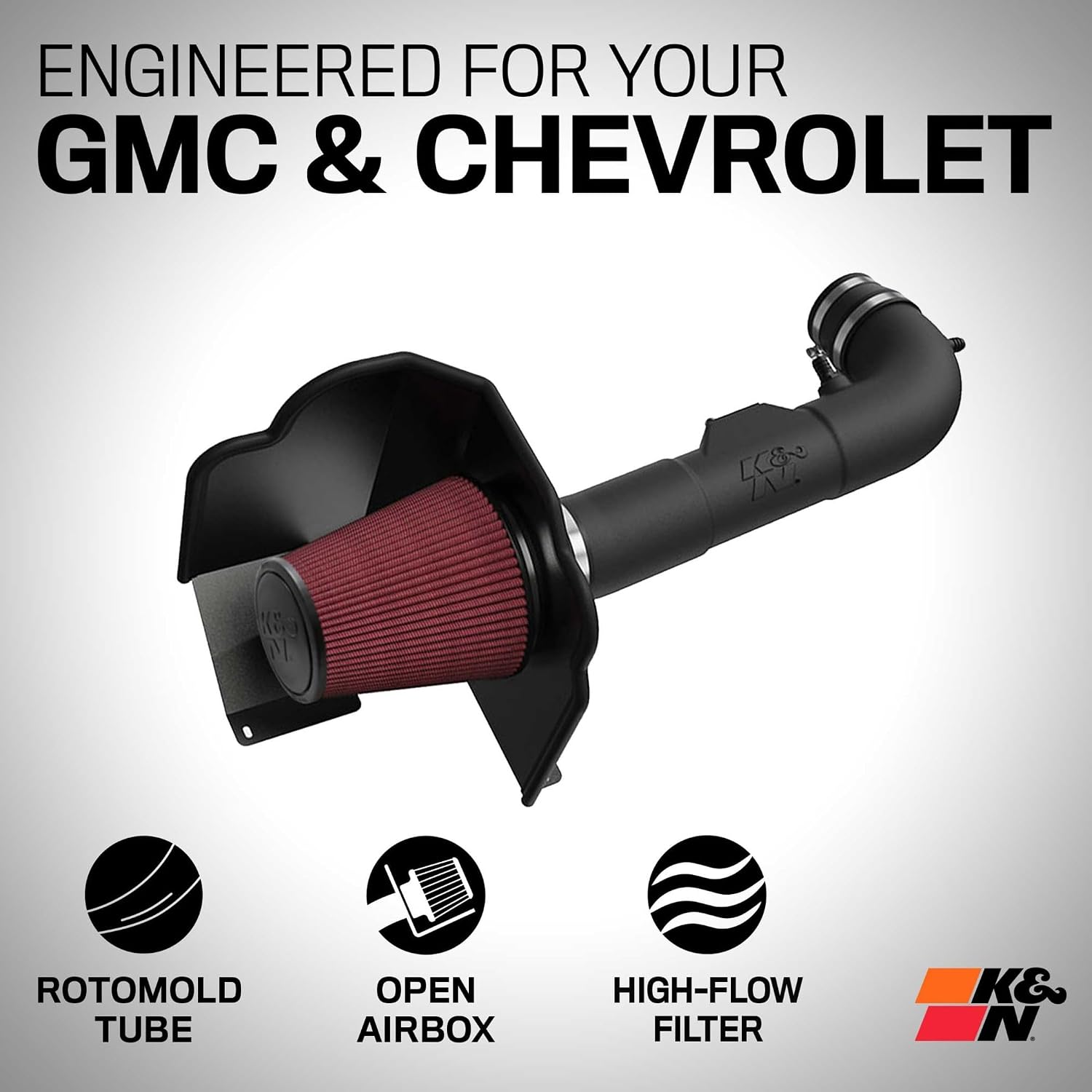
K&N’s published dyno data shows 13–17 whp gains on 5.3L platforms in stock tune. The kit uses a 3.5-inch mandrel-bent aluminum tube, a large-diameter oiled cotton gauze cone filter, and a heat shield that mounts to the factory air duct bracket. Owners consistently report that the heat shield is less effective than it looks — the filter location is close enough to the exhaust manifold that heat soak is a real issue during stop-and-go driving. Real-world gains on hot days in traffic can drop to the low end of that range or below. For a daily driver that also sees occasional track days, the heat soak concern is meaningful. CARB EO number: D-670-4 (confirm current status via the California Air Resources Board EO database before purchase in California).
Airaid 201-249 (GMT800, 5.3/6.0 — their MXP Series)
Airaid’s 201-249 publishes gains of 12–18 whp on the 5.3L LM7 in their dyno summary. The MXP tube is a larger 4-inch diameter, which is where Airaid’s advantage over K&N becomes tangible as you add supporting mods — more headroom for future airflow gains. The SynthaMax dry filter on MXP kits eliminates the re-oiling cycle that causes MAF contamination on oiled filter kits (a real, documented issue that K&N themselves have addressed in tech bulletins). Owners consistently note the MXP heat shield is better engineered — it incorporates foam-sealed mounting points that close off hot underhood air more completely. CARB EO: D-751-13 (verify in the CARB EO database for current standing).
Corsa Performance Intake (GMT800/GMT900, 5.3/6.0)
Corsa’s intake system is less widely discussed than K&N or Airaid, but their published dyno summary shows 15–20 whp gains on 6.0L LQ4 platforms — the strongest gain numbers in this comparison. Corsa routes the intake tube further toward the fender well and uses a sealed airbox design rather than an open cone filter, which addresses heat soak more aggressively. The tradeoff is that it’s a more involved install — owners report 2–3 hours versus 45–60 minutes for the K&N or Airaid. For a 6.0L truck where you’re chasing every number, that extra install time is worth it. For a basic 5.3L daily driver, it’s probably overcomplicated.
Spectre 9903 (4.8L applications)
Spectre’s 9903 is the budget option, and the dyno data reflects it: 8–12 whp on the 4.8L. Owners report solid build quality for the price point and an easy install, but the gains are modest enough that on a 4.8L truck not destined for more mods, you need to be honest with yourself about whether the price-to-gain ratio justifies it. If the truck is a genuine daily driver that will stay stock otherwise, the answer is probably no. If it’s the first step in a build that includes a tune and exhaust, it makes more sense.
The If-Then Decision Framework
Here’s where this lands for your specific situation:
If you’re on a 5.3L GMT800 truck (1999–2006) and not planning a tune: K&N 57-3042 is the right call. Easy install, proven gains in the 13–17 whp range, widely stocked. Accept the heat soak limitation.
If you’re on a 5.3L GMT900 truck (2007–2013) and planning a tune: Step up to the Airaid MXP. The 4-inch tube gives the tuner more to work with, the dry filter eliminates MAF contamination risk, and the better heat shield keeps the gains consistent across ambient conditions.
If you’re building a 6.0L LQ4 truck for real performance: Corsa’s system earns those extra two hours of install time. The 15–20 whp gain combined with a tune and a throttle body upgrade puts you in a meaningful place.
If you’re on a 4.8L and not adding a tune or other supporting mods: Be realistic. An intake alone on a 4.8L is an enthusiast purchase, not a performance investment. Put the money toward a tune first.
If you’re in California: Confirm the CARB EO number for any kit before purchase. The California Air Resources Board maintains an active EO database — search by manufacturer and part number. Non-CARB-legal intakes on a street-registered vehicle in California create smog inspection failure risk that’s not worth the gain.
One last note: every number in this article assumes your MAF sensor is clean and your fuel trims are in range before install. A dirty MAF or a truck already running rich will distort your baseline and make the gains look smaller than they are. Pull a MAF reading with a scan tool before you order anything — it takes ten minutes and it’ll tell you whether the intake is actually your next move.