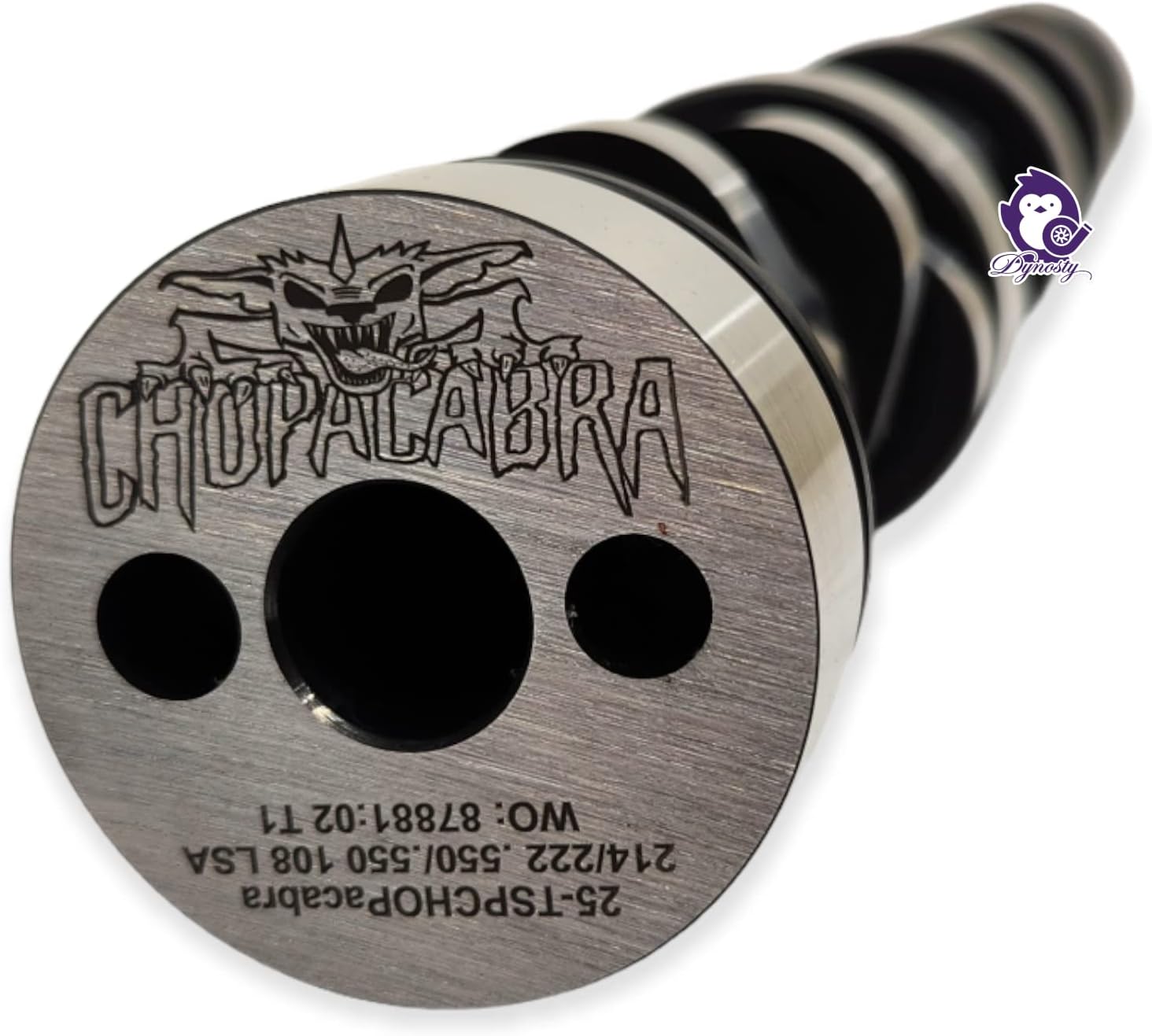
The camshaft is the brain of your engine’s breathing cycle. Every time an intake or exhaust valve opens — letting air and fuel in, pushing spent gases out — it does so because a lobe on the camshaft told it to. The factory cam in your LS-powered truck or SUV was engineered for fuel economy, emissions compliance, and smooth idle quality at the cost of peak power. An aftermarket camshaft changes that equation by opening the valves wider (more lift), holding them open longer (more duration), and timing those events differently relative to piston position (cam phasing). The result, when the cam is matched correctly to the rest of your engine, is a meaningful increase in horsepower and torque — typically 40 to 80 rear-wheel horsepower on a naturally aspirated 5.3 or 6.0 with supporting bolt-ons. This guide covers the three most common LS truck displacements — the 4.8 LR4, the 5.3 LM7/L59/LM4, and the 6.0 LQ4/LQ9 — with platform-specific cam specs, spring requirements, and an honest accounting of what you give up at idle.
| EDITOR'S PICK[BTR Brian Tooley Racing Stage 2](https://www.amazon.com/dp/B0DKK21FMC?tag=greenflower20-20)… | Mid-tier[BTR Brian Tooley Racing Truck N](https://www.amazon.com/dp/B09KNCLM7R?tag=greenflower20-20)… | Budget pick[Sloppy Mechanics Stage 2 Camsha](https://www.amazon.com/dp/B0BGBLK6TL?tag=greenflower20-20)… | |
|---|---|---|---|
| Intended Use | Stage 2 | Truck Norris | Stage 2 |
| Pushrods Included | ✓ | — | — |
| Lifters Included | — | — | ✓ |
| Oil Pump Included | — | — | ✓ |
| Timing Chain | — | — | ✓ |
| Price | $824.47 | $695.85 | $339.99 |
| See on Amazon → | See on Amazon → | See on Amazon → |
Why the LS Truck Platform Responds So Well to a Cam Swap
The Gen III and Gen IV LS truck engines are architecturally over-built for their factory power ratings. The iron-block 5.3 LM7 made 270 hp at the crank when it debuted in 1999 trucks. That same block, with just a cam swap, quality valve springs, and a tune, routinely makes 380–420 rear-wheel horsepower on a chassis dyno — a number the factory rotating assembly and oiling system handles without complaint.
Per Engine Labs’ 2023 analysis of LS cam testing data, the factory cam profiles in LS truck engines were deliberately softened to meet NVH (noise, vibration, harshness) targets and Tier 2 emissions standards. That means there’s genuine performance left on the table at the camshaft level alone, without touching displacement, compression, or forced induction.
The practical result: a cam swap is often the highest return-on-investment modification on a naturally aspirated LS truck build. Budget roughly $600–$900 for the camshaft itself, $250–$400 for a quality spring kit, and $400–$700 for a proper tune — and you’re looking at a total outlay of $1,200–$2,000 for gains that would cost $3,500+ through any other path.
Stock vs. Aftermarket: Understanding the Core Spec Numbers
Before comparing specific grinds, you need to be comfortable reading cam specs. Three numbers drive everything:
Lift — how far the valve opens, measured in inches. More lift = more airflow, up to the point where the port or valve pocket becomes the restriction. Stock LS truck cams typically run 0.467–0.480 in. lift. Aggressive street grinds run 0.550–0.600 in. Race cams push 0.620 in. and above, at which point you need machined valve reliefs in the pistons.
Duration at 0.050 in. — the standard industry measurement for how long the valve stays open, expressed in degrees of crankshaft rotation. Stock LS truck cams run 193–200° intake / 200–207° exhaust. A good street performance cam lands in the 210–224° intake range. Aggressive cams pushing 228° and above start compromising idle quality and low-rpm vacuum.
Lobe Separation Angle (LSA) — the angle between the intake and exhaust lobe centerlines, measured in camshaft degrees. LSA controls idle quality, torque curve shape, and how much the intake and exhaust valves overlap (both open simultaneously). Tighter LSA (110°) builds cylinder pressure and creates that lopey idle sound enthusiasts love. Wider LSA (114–116°) produces a smoother idle and maintains more low-rpm torque, which matters for trucks that still tow or see highway miles.
By the Numbers: Stock vs. Common Aftermarket Profiles
| Cam Profile | Lift (In/Ex) | Duration @ 0.050 (In/Ex) | LSA | Typical RWHP Gain |
|---|---|---|---|---|
| Stock 5.3 LM7 | 0.467 / 0.480 | 196° / 207° | 116° | Baseline |
| COMP 54-456-11 (Stage 2) | 0.544 / 0.544 | 218° / 228° | 112° | +45–60 rwhp |
| Cam Motion 3-Bolt Stage 3 | 0.581 / 0.581 | 224° / 232° | 112° | +65–80 rwhp |
| Livernois “Truck Terrorizer” | 0.560 / 0.565 | 219° / 225° | 114° | +55–70 rwhp |
Power gains above are aggregated from manufacturer dyno sheets and owner-reported chassis dyno results on otherwise stock or bolt-on engines. Actual gains vary by supporting mods, tune quality, and test conditions.
Platform-Specific Recommendations: 4.8, 5.3, and 6.0
4.8 LR4 (1999–2007 Silverado/Sierra/Tahoe)
The 4.8 is the most frequently overlooked LS truck engine, which is a mistake. Its smaller bore (3.780 in. vs. 3.780 in. shared with the 5.3, but shorter 3.267 in. stroke) means it’s naturally rev-happy compared to the larger displacement variants. The tradeoff: it makes less low-rpm torque to begin with, so an overly aggressive cam with wide-open duration will hollow out the torque curve in a way that hurts real-world driveability.
Recommended cam range for the 4.8: 212–220° intake duration / 218–226° exhaust duration, 0.540–0.570 in. lift, 112–114° LSA. COMP Cams’ published data on their 54-454-11 grind shows consistent gains of 38–50 rwhp on otherwise stock 4.8 engines, with the torque peak maintaining usability above 3,000 rpm.
Spring requirement: The 4.8 stock retainers are compatible with most bolt-in cam swaps, but the factory springs are rated for approximately 105–110 lb seat pressure — insufficient for any aftermarket profile above 0.540 in. lift. COMP Cams’ 26918-16 spring kit (rated at 130 lb seat / 340 lb open) is a direct fit and the most commonly referenced solution in builder community write-ups. Per Hot Rod’s 2022 LS cam swap guide, the stock beehive springs on late 4.8 engines can float at 5,800+ rpm with aggressive aftermarket cams, making spring replacement non-negotiable on any cam with lift above 0.540 in.
5.3 LM7/L59/LM4/LC9 (1999–2013, Various Trucks and SUVs)
The 5.3 is the bread-and-butter LS truck platform and the one with the richest supporting documentation. More dyno data exists for this engine than any other LS truck variant, and the aftermarket cam selection is correspondingly deep.
Important fitment note: The 5.3 spans Gen III (1999–2007, single-bolt cam) and Gen IV (2007–2013, three-bolt cam) configurations. These are NOT interchangeable. The three-bolt cam nose on Gen IV engines integrates with the variable valve timing (VVT/AFM) system. If you’re upgrading a Gen IV 5.3 and deleting AFM/VVT (Active Fuel Management), you need a cam matched to the converted single-bolt configuration OR a three-bolt compatible aftermarket grind — and your tuner must disable the AFM system in the ECM. Running an aggressive cam with AFM still active will cause misfires and trigger DTC codes.
Recommended cam range for the 5.3 street/strip build: 218–224° intake / 228–234° exhaust, 0.560–0.600 in. lift, 112–114° LSA. Cam Motion’s 2023 published dyno data for their Stage 3 LS truck grind on a 5.3 LM7 with bolt-ons (cold-air intake, long-tube headers, catback exhaust) shows 412 rwhp and 395 rwhp at the tire — roughly 65 rwhp over a similarly bolt-on’d stock cam combination.
For tow-capable builds: Livernois Motorsports’ “Truck Terrorizer” grind is specifically engineered for the 5.3 with 114° LSA, which preserves more low-rpm torque than the tighter 112° options. Their development notes indicate that peak torque stays within 2% of a stock cam’s torque reading below 2,500 rpm — relevant if you’re still running your truck on a tow bar on weekends.
Spring requirement: Any 5.3 cam above 0.550 in. lift requires upgraded springs. On Gen III engines, COMP’s PAC-1218 single-spring kit is commonly paired with standard-bore retainers. On Gen IV engines, PAC Racing Springs’ LS Truck series (RPM-1218 set) is the preferred reference in builder documentation due to its compatibility with the existing retainer geometry without machining.
6.0 LQ4/LQ9 (1999–2007 Silverado HD, Tahoe, Escalade)
The 6.0 is the platform for builders who want peak power from a naturally aspirated combination. Its 4.000 in. bore and 3.622 in. stroke move more air at lower rpm than the 5.3 and respond even more aggressively to aggressive cam profiles because the larger displacement generates enough cylinder pressure to use the added duration effectively.
Fitment exclusions: The LS2-based 6.0 in the 2005–2007 Corvette shares displacement but NOT cam compatibility — do not spec LS truck cam grinds for LS2 applications. Additionally, the 6.0 LY6 introduced in 2007+ trucks is a Gen IV VVT engine and requires the same VVT/AFM deletion protocol as the Gen IV 5.3.
Recommended cam range for the 6.0: 224–232° intake / 230–238° exhaust, 0.580–0.620 in. lift, 110–114° LSA. On a 6.0 LQ4 with long-tube headers and a quality tune, COMP Cams’ published results for their 54-468-11 grind show 460–475 rwhp in multiple documented dyno pulls. That’s approaching forced-induction 5.3 territory from a naturally aspirated 6.0.
Spring requirement: The 6.0’s larger valve train sees more stress with aggressive cams. Any grind above 0.580 in. lift on a 6.0 should be paired with titanium retainers or at minimum PAC Racing’s double-spring kit. COMP Cams’ technical specification documents explicitly flag that their Stage 4 6.0 grinds (above 0.610 in. lift) are not safe with factory retainers under sustained high-rpm use.
Idle Quality: The Trade-Off Nobody Reads Enough About
This is where honest expectations matter more than any dyno number.
A cam with 224°+ intake duration and 112° LSA will not idle like a stock truck. It will lope — uneven, burbling, with rpm fluctuating 50–100 rpm at hot idle. Vacuum at idle will drop to 8–12 in. Hg versus the stock 18–22 in. Hg, which directly affects:
- Power brake boost: You may need a vacuum-assisted brake booster upgrade or a hydroboost conversion if you’re running very aggressive cams. Engine Labs’ technical coverage consistently flags this as the most commonly overlooked consequence of aggressive cam installs on street trucks.
- Automatic transmission behavior: Low manifold vacuum confuses stock torque converter lock-up calibration. Your tuner must address this in the transmission tables, particularly on 4L60E and 4L80E applications.
- Evaporative emissions (EVAP) system function: Modern EVAP leak detection relies on stable idle vacuum. Aggressive cams trigger EVAP codes frequently on emissions-tested vehicles. CARB EO numbers do not exist for aftermarket camshaft grinds — camshafts are not CARB-exempt parts, and any cam replacement on a California-registered vehicle not used exclusively for racing constitutes a modification that can fail a visual inspection. California readers should consult the California BAR (Bureau of Automotive Repair) regulations before proceeding.
The if/then decision rule:
- If your truck is a daily driver that still tows occasionally and lives in an emissions-tested state: target 216–220° intake / 112–114° LSA. You’ll gain 40–50 rwhp, idle will be slightly lopey but manageable, and vacuum-dependent systems will function normally.
- If your truck is a dedicated strip/track vehicle or a show-and-performance build that doesn’t need to pass emissions: 224–232° intake / 110–112° LSA extracts maximum power and produces the idle character the platform is known for.
- If you’re on a 4.8 and budget is the primary constraint: the 212–216° / 114° LSA range gives you 85% of the power gain with nearly stock idle quality and no vacuum system headaches.
The cam swap remains the single best investment per dollar on a naturally aspirated LS truck build — but only when the supporting hardware (springs, tune, vacuum systems) gets the same attention as the cam selection itself.