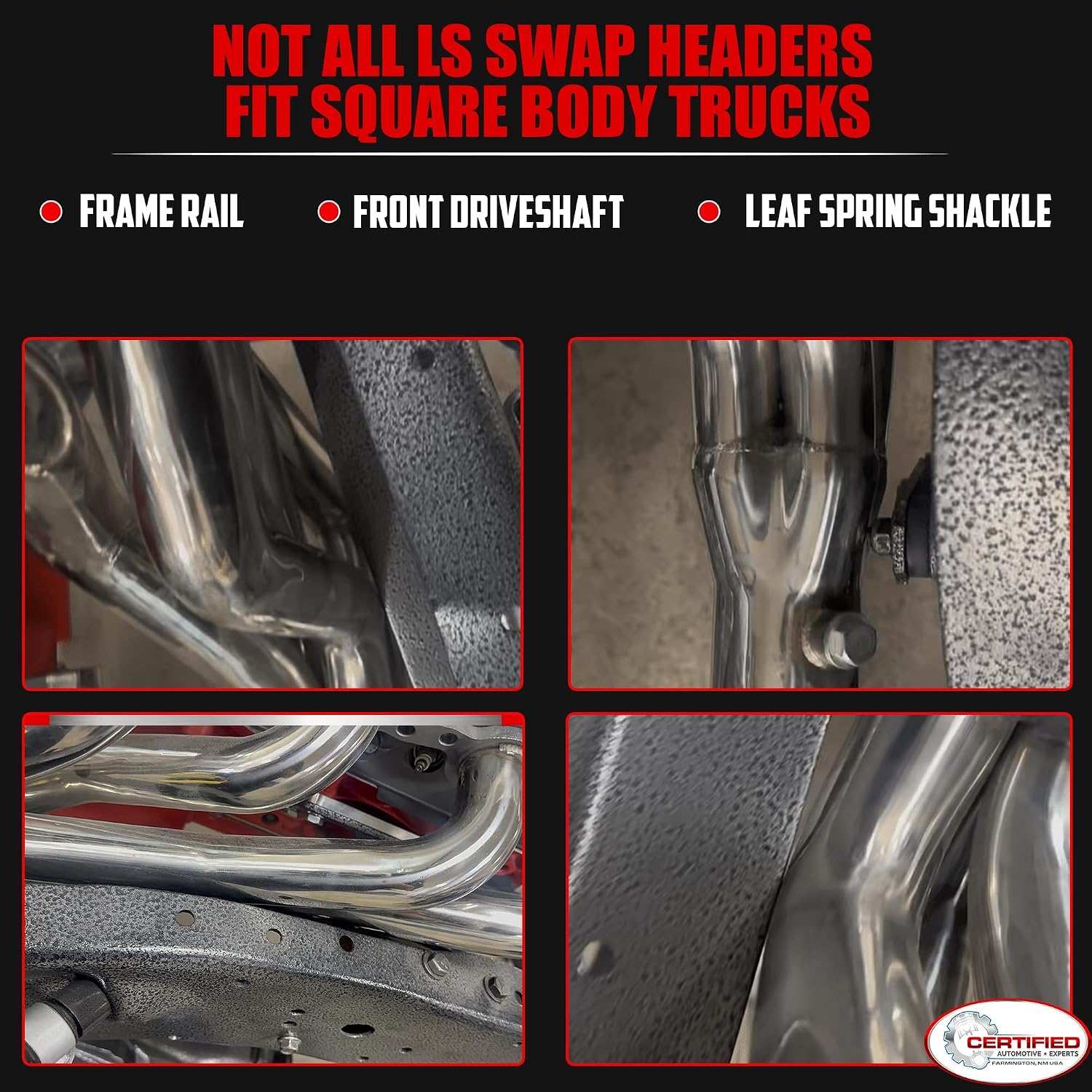
If you’ve ever dropped an LS engine — General Motors’ legendary small-block V8 family, first introduced in 1997 and now the go-to swap engine for its combination of compact size, massive aftermarket support, and strong power potential — into a classic C10 or square-body Chevy truck, you already know the exhaust routing problem. The LS block sits lower and further back than the original small-block it replaces, and the square-body’s frame rails (the two main structural beams running front to back under the truck) were never designed around it. That mismatch is exactly why picking the right long-tube headers — the exhaust pipes that bolt directly to each side of the engine and merge into a collector before connecting to the rest of your exhaust system — is one of the most consequential decisions in the whole build. Get it right and you gain 25–40 horsepower at the wheels while everything clears cleanly. Get it wrong and you’re grinding metal against frame, fighting collector clearance on every bump, or pulling the headers back off in six months because a coating failed. This guide covers fitment by year and cab style, the three coating tiers worth considering, and how collector diameter affects what comes after the headers.
Why Square-Body LS Header Fitment Is More Complicated Than It Looks
The “square-body” generation runs from 1973 through 1987 for C10 and C20 half-ton and three-quarter-ton trucks, with the C30 one-ton sharing the same basic chassis through 1988. Within that window there are meaningful differences that affect header fitment:
- 1973–1980 models have a narrower firewall-to-crossmember dimension and slightly different motor mount pocket geometry, especially if the original mount pads haven’t been modified.
- 1981–1987 models shifted the frame crossmember position slightly and are the “easiest” fit for most LS swap header kits designed for this generation.
- Crew cab and Suburban variants share the basic frame dimensions but often have different steering shaft routing that can conflict with the passenger-side primary tubes on certain kits.
The LS engine family also isn’t a monolith. The most common swap candidates are the LM7 (5.3L iron block, found in late-1990s through mid-2000s half-ton trucks), the LQ4/LQ9 (6.0L iron block, common in HD trucks and vans), and the LS1/LS6 (aluminum 5.7L, from F-bodies and Corvettes). All share the same block deck height and bellhousing pattern, but the valley cover height and accessory bracket configurations differ, which affects how close the primary tubes can run before they hit something.
Per the Hooker Blackheart LS Swap Header Fitment Guide (Rev. 2024), the primary tube routing on the driver’s side is the consistent chokepoint: the steering shaft, brake booster, and frame rail all compete for the same real estate. Kits that don’t account for a power-brake-equipped square-body will either require modifying the brake booster bracket or will arrive with instructions to swap to a manual brake setup — something worth knowing before you order.
The Header Kits That Actually Fit: Brand-by-Brand Breakdown
Hooker Blackheart (PN 70101307-RHKR and variants)
Hooker’s Blackheart line is the most square-body-specific LS header offering on the market as of 2025–2026. The kit is designed around 1973–1987 C10 and C20 applications with the LS engine mounted using either factory-style LS swap mounts or Hooker’s own mount kit. Primary tube diameter is 1-7/8 inches, and the collectors terminate at 3 inches. The fitment guide specifies clearance for power brakes on 1981–1987 models; 1973–1980 owners report that minor steering shaft modification is sometimes needed.
What it does NOT fit: Extended cab configurations with the factory transfer case crossmember in place, Suburban models, or any C10 with the original small-block motor mounts still in the frame (you need the LS conversion mounts first).
Owners in long-run forum threads and in Hot Rod Magazine’s January 2023 C10 LS swap feature consistently report 28–35 rear-wheel horsepower gains over cast-iron exhaust manifolds on a stock or mildly modified 5.3L LM7, measured on a Mustang chassis dyno.
Hedman Hedders (PN 69400 series)
Hedman’s square-body LS offerings target the 1973–1987 frame with slightly smaller 1-3/4-inch primary tubes and a 3-inch collector, making them a better fit for builds where the engine bay is tighter or where the budget is more constrained. Per the Hedman Hedders C10/C20 LS Swap Application Catalog (2023 edition), these headers clear the stock steering shaft on power-brake-equipped 1981–1987 trucks without modification — a genuine advantage over some competitors.
The tradeoff: the smaller primary tube diameter puts a ceiling on top-end power gains. Engine Labs’ published dyno comparison work (“Long-Tube vs. Shorty Headers: What the Dyno Actually Says,” March 2022) shows that for NA (naturally aspirated) LS combinations making under 450 whp (wheel horsepower), the difference between 1-3/4-inch and 1-7/8-inch primaries is typically 8–12 horsepower at peak, with the 1-3/4-inch tube maintaining a slight midrange torque advantage below 4,500 RPM. If your build is a daily driver or a cruiser making 350–420 whp, the Hedman setup is the more practical choice.
What it does NOT fit: C20 or C30 models with the heavy-duty front axle package (Dana 60 front), which uses a steering drag link that conflicts with the driver-side collector on this specific kit.
American Powertrain / Custom Fab Options
For builds running a T56 or Tremec TKX manual transmission behind the LS — a common choice in the square-body swap community — the transmission tunnel clearance changes the collector positioning math entirely. The American Powertrain LS Swap Reference Manual (Section 4: Exhaust Routing) notes that 3-inch collectors on most bolt-on kits will contact the TKX tailshaft housing without a collector spacer or an offset collector. Their recommendation for manual-trans square-body builds is a 3-inch-to-2.5-inch stepped collector that drops the merge point below the trans tunnel before transitioning back to 3-inch downstream.
Coating Tiers: What Survives the Heat, What Doesn’t
Long-tube headers on an LS swap run hot — sustained exhaust gas temperatures (EGT) of 1,200–1,600°F at the collector are normal. The coating you choose determines whether you’re dealing with rust and discoloration at 30,000 miles or headers that still look and function correctly at 80,000. There are three real tiers:
Tier 1 — Raw Steel (no coating): Uncoated headers will rust on the outer surface within one heat cycle in any humid environment. Fine if you’re racing on a dry-climate track car and plan to swap headers seasonally, but not a real option for anything that sees rain or daily use.
Tier 2 — Manufacturer Ceramic Coating (factory applied): Most header kits come in a “ceramic-coated” version at a $60–$120 price premium. Quality varies significantly by brand. Hooker’s factory ceramic coating is a thin-film application rated to approximately 1,200°F on the outer surface. Owners consistently report it holds up well for 3–5 years in street use before showing surface oxidation at the collector, which runs the hottest.
Tier 3 — Jet-Hot or Professional Ceramic (aftermarket applied): Jet-Hot’s thermal barrier coating, per their 2023 technical bulletin on ceramic coating durability at sustained EGT, is rated to 1,800°F on the outer surface and penetrates the steel surface rather than sitting on top of it. The result is both better heat retention inside the tube (keeping exhaust velocity high, which supports scavenging — the way exhaust pulses help pull fresh intake charge into the cylinder) and dramatically better corrosion resistance. The cost is an additional $250–$400 applied to a set of headers after purchase. For a square-body that sees road salt, this is the only coating worth speccing.
By the numbers:
| Coating Type | Rated Outer Temp | Typical Cost Added | Expected Life (Street) |
|---|---|---|---|
| Raw steel | N/A | $0 | 1–3 years before surface rust |
| Factory ceramic | ~1,200°F | $60–$120 | 3–5 years |
| Jet-Hot / pro ceramic | ~1,800°F | $250–$400 | 8–12+ years |
Collector Size and What Comes After the Headers
The collector is where all four primary tubes on each side merge into a single pipe. For square-body LS swaps, the dominant choice is 3-inch collectors, and virtually every bolt-on kit listed above uses them. That sizing drives everything downstream.
A 3-inch collector wants to feed into a 3-inch exhaust system — either a true dual 3-inch setup running separate pipes from each collector back to mufflers, or a Y-pipe merger into a single 3.5-inch or 4-inch pipe for a single-exit system. Per the American Powertrain reference manual, trying to neck down from a 3-inch collector to a 2.5-inch pipe to use a cheaper muffler setup will cost 15–20 horsepower on a 400+ whp LS combination by creating backpressure at exactly the wrong point in the exhaust path.
For 3-inch collector header kits, the muffler sizing that supports the system without restriction:
- Single exit: 3.5-inch pipe into a high-flow muffler (Magnaflow 14832 or Borla equivalent)
- True dual: 3-inch per side into 2.5-inch mufflers with x-pipe crossover
The crossover (x-pipe or h-pipe — a connecting pipe between the driver and passenger exhaust runs that balances pressure between the two sides) is worth including on any square-body LS swap making over 350 whp. Engine Labs’ dyno data consistently shows 8–14 horsepower gains from an x-pipe versus a straight dual system at peak power, with torque gains showing up more broadly across the mid-range RPM band.
The Decision Framework: If X, Then Y
If your square-body is a 1981–1987 C10 street cruiser with a 5.3L LM7 and power brakes, the Hedman 69400 series is the cleanest fitment with the fewest modifications required. Add factory ceramic coating if you’re in a dry climate; spec Jet-Hot if you’re in a rust-belt state.
If your build is a 1973–1987 C10 with a 6.0L LQ4 or LS1 targeting 450–550 whp, the Hooker Blackheart kit’s 1-7/8-inch primaries give you headroom the Hedman setup doesn’t. Budget $300 for professional ceramic coating application and plan for a 3-inch true-dual exhaust system downstream.
If you’re running a manual transmission (T56/TKX), confirm collector clearance against your trans tunnel before ordering any bolt-on kit. The stepped collector approach from the American Powertrain reference manual is the most reliable path, even if it requires custom fab at the collector-to-pipe transition.
If you’re on a 1973–1980 frame, plan for the possibility of steering shaft modification regardless of which kit you choose — no current production header completely eliminates that concern on the early frame, per owner reports aggregated across the Hooker and Hedman fitment documentation.
The headers are the first constraint in the exhaust chain, and on a square-body LS swap, they’re also the hardest to change after the fact. Get the fitment and coating right the first time and everything downstream is straightforward. Rush the decision and you’re pulling the engine again.