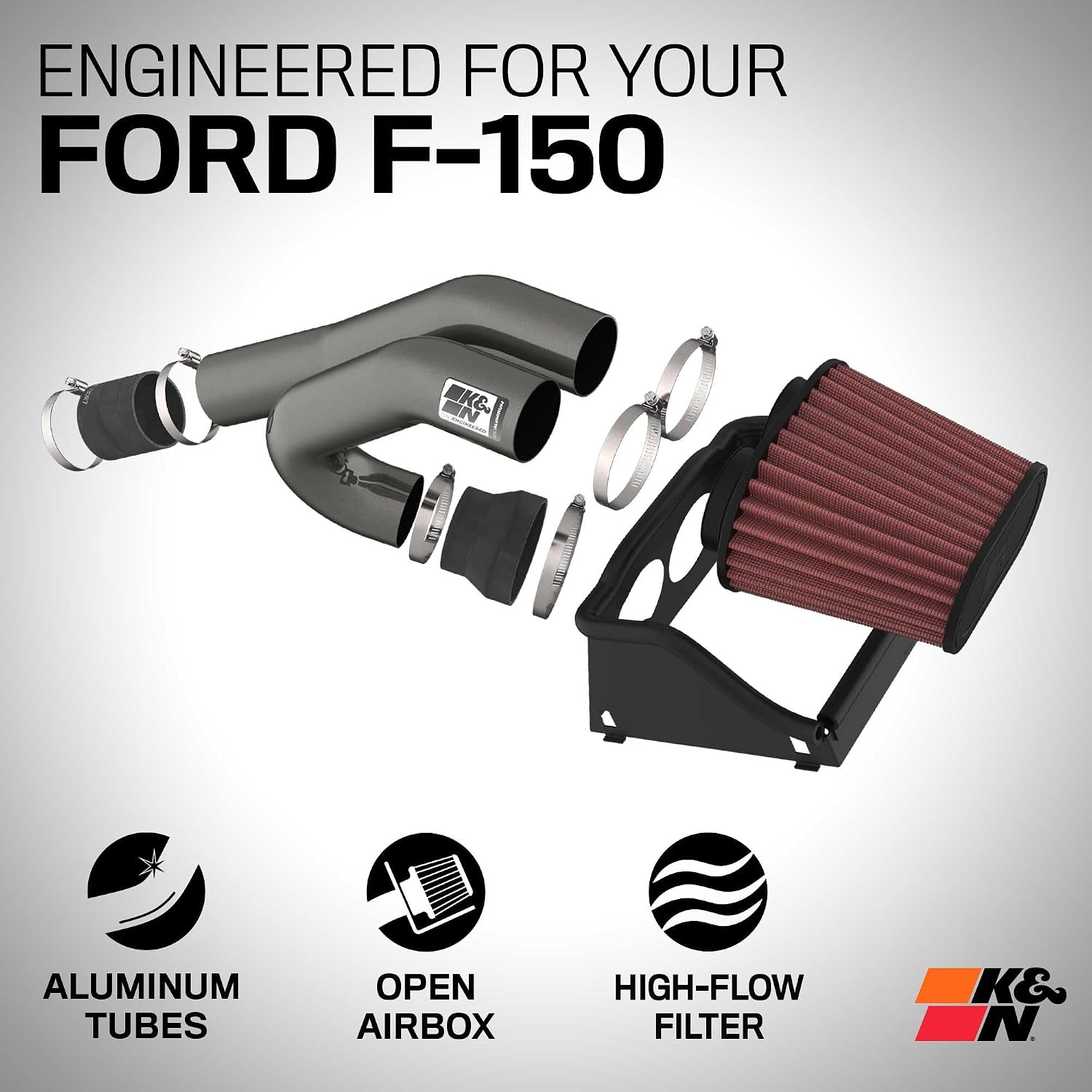
A cold air intake is one of the simplest bolt-on upgrades you can make to a truck: it replaces the factory airbox — the plastic box that holds the engine’s air filter — with a larger, straighter intake tube and a high-flow filter. The goal is to let the engine breathe more freely. More air flow means the engine management system (the computer that controls fuel and timing) can pull more power, especially under hard acceleration. On the Ford F-150 specifically, this is worth paying close attention to because the truck comes in two very different engine families — the turbocharged EcoBoost V6 lineup and the naturally aspirated (no turbo) 5.0L Coyote V8 — and how much power a cold air intake actually adds depends almost entirely on which engine you have, which generation of truck you’re running, and whether the tune is set up to take advantage of it. This guide breaks down the real dyno-verified gains, the exact fitment matrix by year and trim, what to look out for at the California smog station, and a clear decision rule for each engine family.
| EDITOR'S PICKK&N Cold Air Intake System: Hig… | Mid-tierK&N Cold Air Intake System: Hig… | Budget pick[EVIL ENERGY Cold Air Intake Com…](https://www.amazon.com/dp/B0G442W1FB?tag=greenflower20-20) | |
|---|---|---|---|
| Filter Type | High-Flow | High-Flow | — |
| Material | Metal Tube | — | — |
| Heat Shield | — | — | ✓ |
| Year Range | 2015-2026 | 2011-2014 | 2015-2025 |
| Vehicle | F-150, Expedition, Raptor | F-150 | F-150, Expedition, Navigator |
| Price | $422.99 | $317.99 | $149.99 |
| See on Amazon → | See on Amazon → | See on Amazon → |
EcoBoost Intakes: Why the Turbo Changes the Math
On a turbocharged engine like the 2.7L EcoBoost (available 2015–present) or the 3.5L EcoBoost (available 2011–present), the air intake sits in front of the turbocharger, not after it. That placement means the intake is working in what engineers call the “pre-compressor” position — the turbo is still doing the real work of pressurizing air into the cylinders, but a less restrictive intake path means the turbo has to work less hard to pull the air it needs. The practical result: lower intake air temperatures, marginally better turbo spool, and a modest power bump that, per published dyno data from multiple manufacturers, typically runs 10–25 horsepower at the wheels on stock-tune trucks and climbs to 20–35 whp when paired with a tune.
3.5L EcoBoost (Gen 1: 2011–2016, Gen 2: 2017–2021, Gen 3: 2022–present)
This is the highest-volume application and the one where fitment errors are most common. The Gen 1 and Gen 2 3.5L EcoBoost use different intercooler and manifold packaging, so an intake made for a 2015 will NOT fit a 2018 without adapter work — even though the engine displacement is identical. Always spec your intake to the generation, not just the displacement.
Per S&B Filters’ published product documentation for their F-150 3.5L EcoBoost application, their cold air intake shows a dyno-verified gain of approximately 18–22 whp on a stock 2017–2021 truck at wide-open throttle. AFe Power’s Momentum GT documentation for the same Gen 2 application reports a comparable 20–25 whp improvement over the factory airbox, also on an otherwise stock truck at sea level.
2.7L EcoBoost (2015–present)
The 2.7L is a smaller-displacement twin-scroll turbo setup used in lighter-duty trims. Published dyno documentation from K&N Engineering for their 2.7L F-150 application shows gains in the 12–18 whp range on stock maps. The engine is more sensitive to intake air temperature than the 3.5L because it’s working at higher specific output (power per liter), so sealed-box designs that keep the filter away from underhood heat deliver more consistent gains than open-element setups that sit directly in the engine bay. Owners consistently report that in summer heat, an unsealed intake on the 2.7L can actually lose a few degrees of timing because the ECU detects elevated intake air temps and pulls boost.
What EcoBoost owners frequently get wrong: Buying a “universal” or off-brand intake that doesn’t include a properly sealed heat shield. The factory airbox on these trucks does a surprisingly good job isolating the filter from radiator and exhaust heat. If your aftermarket intake doesn’t match or beat that isolation, real-world gains on hot days will underperform the dyno sheet, which was almost certainly pulled at cooler ambient temps.
CARB note for California EcoBoost owners: The 3.5L and 2.7L EcoBoost intakes from K&N, S&B, and aFe Power each have CARB Executive Orders (EO numbers) covering specific F-150 model years. Before purchasing, cross-reference the EO number against the CARB Executive Orders database at carb.ca.gov. Not every model-year variant is covered under the same EO — a 2019 3.5L may have a different EO status than a 2021 3.5L under the same intake SKU. Buying without checking this risks a smog failure that will cost more to resolve than the intake itself.
Coyote 5.0L Intakes: Naturally Aspirated, Different Expectation Set
The 5.0L Coyote V8 (available in the F-150 from 2011–present across Gen 1, Gen 2, and Gen 3 variants) plays by different rules. Without a turbocharger, the intake is doing all the atmospheric work: there’s no boost multiplier effect, which means absolute airflow restriction matters more and gains are typically more modest in percentage terms.
That said, the Coyote responds particularly well to intake upgrades when the tune is revised to match. Hot Rod Magazine’s published breakdown of bolt-on gains on naturally aspirated engines notes that a cold air intake alone on an untuned NA motor generally delivers 5–12 whp — real but not transformative. Pair the intake with a tune optimized for the new airflow curve, and Roush Performance’s published dyno results for their 2015–2022 F-150 5.0L intake show gains of 15–22 whp at the rear wheels when the PCM (the F-150’s engine computer) has been recalibrated.
Generation fitment breakdown for the Coyote:
- Gen 1 (2011–2014): These use the earlier Coyote with a single throttle body and different mass air flow sensor (MAF — the sensor that measures how much air enters the engine) placement. Intakes for this generation will not transfer to Gen 2 trucks. Confirm MAF sensor transfer compatibility before buying — some intakes require you to reuse the factory MAF housing.
- Gen 2 (2015–2017): Updated intake manifold packaging. Most major brands (K&N, aFe, Roush, Volant) produce application-specific kits here. Gen 2 is the most heavily tested generation in owner communities.
- Gen 3 (2018–present): The Gen 3 5.0L received significant port injection and direct injection architecture changes. Intake routing differs from Gen 2. Verify the intake SKU specifically calls out 2018+ before ordering.
Trim-level fitment note: The Raptor (which uses the 3.5L High Output EcoBoost, not the 5.0L) does NOT share intake fitment with any standard 5.0L or standard 3.5L intake. The Raptor’s engine bay geometry and intercooler placement are entirely different. Most standard-cab and SuperCrew 5.0L fitments also do not cover the 2021+ F-150 with the optional PowerBoost hybrid drivetrain — the hybrid system has auxiliary components that occupy the standard intake routing space.
By the Numbers: Realistic Gain Ranges by Engine
| Engine | Intake Only (Stock Tune) | Intake + Tune |
|---|---|---|
| 3.5L EcoBoost Gen 2 (2017–2021) | 18–25 whp | 25–40 whp |
| 2.7L EcoBoost (2015–present) | 12–18 whp | 18–28 whp |
| 5.0L Coyote Gen 2 (2015–2017) | 8–12 whp | 15–22 whp |
| 5.0L Coyote Gen 3 (2018–present) | 7–11 whp | 14–20 whp |
Sources: K&N Engineering product documentation; S&B Filters dyno sheets; Roush Performance 5.0L intake results; aFe Power Momentum GT documentation. All figures are at the rear wheels on otherwise stock trucks at sea level. Actual gains will vary with altitude, ambient temp, and tune calibration.
Picking the Right Kit: Tradeoffs You Need to Name Before You Buy
Sealed box vs. open-element: This is the decision most intermediate builders underweight. An open-element cone filter sitting in the engine bay looks aggressive and does flow more air in a controlled environment, but on a truck that sits in traffic or idles at operating temp, the underhood temps regularly exceed 130–160°F. The MAF sensor and the ECU will react to elevated intake air temps by pulling timing and (on the EcoBoost) reducing boost pressure. Published data from aFe Power’s own intake comparisons shows that their sealed-box designs with heat shields maintain intake air temperatures 20–35°F cooler than open-element alternatives under stop-and-go conditions. If this truck sees any sustained highway or track use, seal matters more than the filter surface area the marketing shows.
Tune dependency on EcoBoost: On a turbocharged application, the ECU’s boost control strategy was written around the factory intake restriction. Swap to a free-flowing intake and you may see modest untuned gains — the turbo will overspool slightly in some conditions — but you’re leaving most of the potential on the table. If you’re running the 3.5L EcoBoost and you’re not planning a tune, the intake’s real-world improvement will sit at the low end of published ranges. If a tune is in the plan at all, buy the intake first and get the tune after — the calibrator needs to see your actual intake to set the MAF transfer function correctly.
CARB EO status on the Coyote: Coyote 5.0L intakes from K&N, aFe, and Volant carry CARB EOs for specific year ranges, but the coverage gaps are real. The 2021+ Gen 3 Coyote is not covered under older EOs written for 2018–2020 applications, even if the part physically fits. Verify your exact model year against the current CARB Executive Orders database before purchase.
What to avoid: Generic “fits most V8 trucks” listings that don’t name a Ford-specific MAF housing adapter. The F-150’s MAF sensor is calibrated to a specific inlet diameter and flow characteristic — if the intake tube changes that diameter without a proper recalibration or a matched housing, you’ll see lean/rich fault codes and the ECU may throw a check engine light.
The Decision Rule
If you’re running the 3.5L EcoBoost (Gen 2 or Gen 3) and you have a tune in the pipeline, a sealed cold air intake from S&B or aFe Power with a confirmed CARB EO for your model year is the correct sequence: intake first, tune second. Expect 25–40 whp all-in and verify the MAF housing is a direct fit.
If you’re on the 2.7L EcoBoost and the truck sees summer heat, prioritize a sealed-box design — the open-element gains on paper disappear in real conditions. K&N’s sealed application for the 2.7L covers 2015–present with a confirmed CARB EO through 2024 model years per their current documentation.
If you’re on the 5.0L Coyote and you’re not tuning, the honest answer is that a cold air intake alone delivers modest gains — real, but single digits at the wheels on a daily driver. It’s a better investment as part of a broader mod package (headers + tune + intake together) where the tune can optimize the whole system. If you’re a California Coyote owner, do the EO check before you buy anything — the Gen 3 coverage picture has changed since 2023 and not every retailer’s fitment guide reflects the current EO list.
In every case: confirm generation, confirm trim, and confirm CARB status before the order ships. The intake market for the F-150 is mature enough that the right bolt-in kit exists for almost every application — the mistakes happen when builders buy on displacement alone without checking the generation break points.