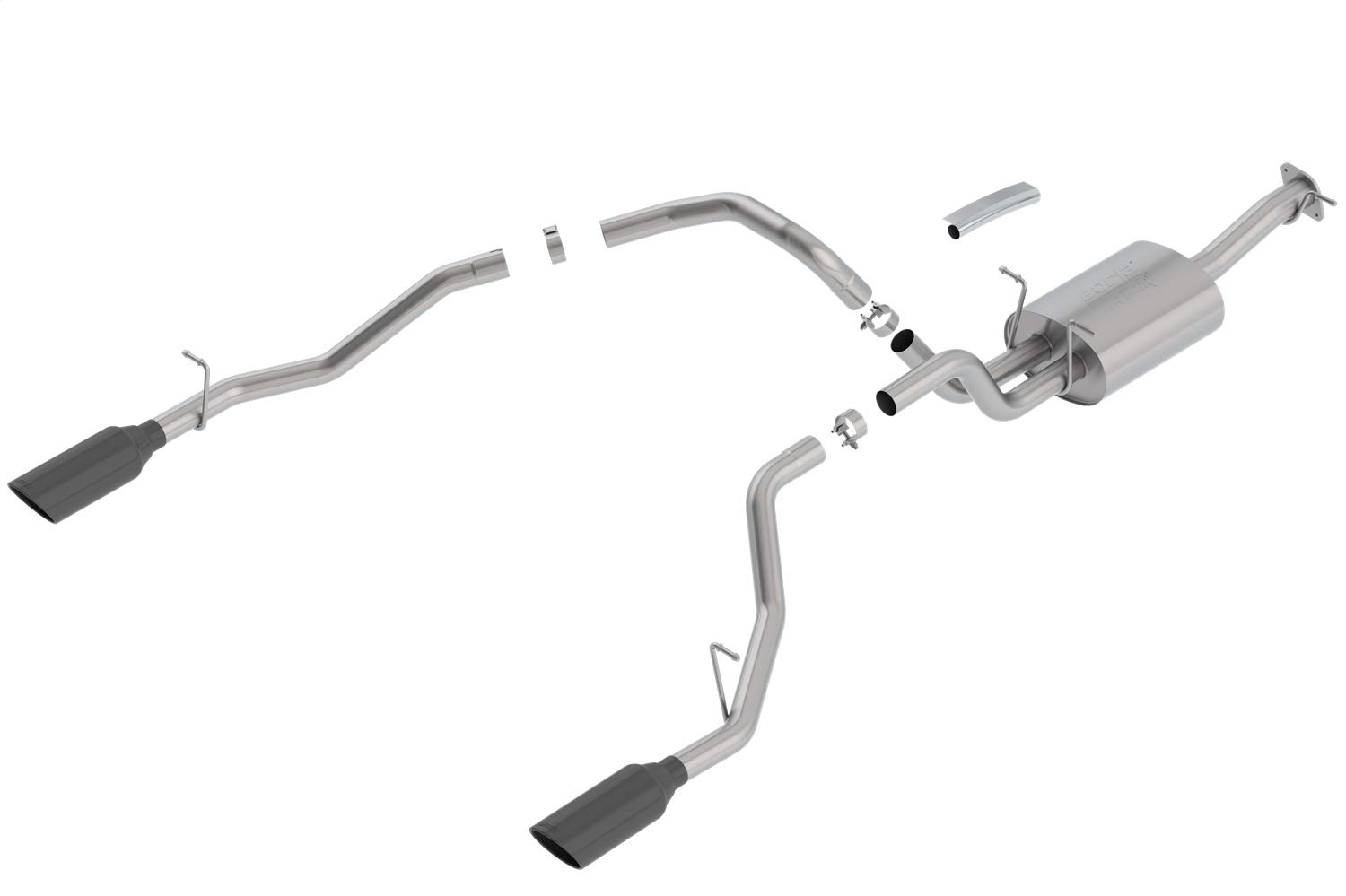
A cat-back exhaust system is the section of your truck’s exhaust that begins right after the catalytic converter (the emissions-control device bolted close to the engine) and runs all the way to the tip you see hanging out the back bumper. Because it replaces only the downstream piping and muffler — not the converter itself — it’s 50-state legal in most configurations and bolt-on in an afternoon with basic hand tools. The trade-off that nobody warns you about up front: sound character and drone (a low, resonant hum at steady highway speeds that turns a pleasant rumble into an 80-mph headache) vary enormously between brands, even on the same truck. This guide gives you the real-world decibel benchmarks, drone ratings from aggregated owner reports, and the platform-specific fitment notes you need to make one purchase decision instead of two.
| EDITOR'S PICK[BORLA 140449 Cat-Back Performan…](https://www.amazon.com/dp/B00IFWMGDY?tag=greenflower20-20) | Mid-tier[MagnaFlow Performance Exhaust S…](https://www.amazon.com/dp/B074KGJZYT?tag=greenflower20-20) | Budget pick[Flowmaster 717787 FlowFX Cat-Ba…](https://www.amazon.com/dp/B07FKHZDT3?tag=greenflower20-20) | |
|---|---|---|---|
| Material | T-304 Stainless Steel | Black Coated | Stainless Steel |
| Exit Style | Dual Split Rear | Dual Split Rear | Dual |
| Tip Size | 4.5" Round | — | 4" |
| Sound Type | S-Type | Street Series | — |
| Tip Material | T-304 Stainless Steel | — | Black Ceramic |
| Pipe Diameter | — | — | 2.5" |
| Price | $1,899.99 | $795.90 | $718.95 |
| See on Amazon → | See on Amazon → | See on Amazon → |
What Drone Actually Is — and Why Trucks Are Especially Prone to It
Drone isn’t just “too loud.” It’s a specific acoustic phenomenon: when exhaust pulses hit a resonant frequency that matches the cab’s natural flex frequency, usually in the 55–80 mph cruise band. The result is a standing sound wave inside the cab that’s less about volume and more about fatigue — you can feel it in your chest and ears long after you’ve tuned out the road noise.
Trucks and body-on-frame SUVs (F-150, Silverado/Sierra, Ram 1500, Tundra, Tahoe/Yukon, Expedition) are more susceptible than unibody cars for three reasons:
- Long exhaust runs. A full-size pickup’s exhaust path from converter to tip can exceed 10 feet. More pipe means more opportunities for harmonic buildup.
- Cab isolation gaps. BOF trucks use body mounts as isolation points, but at certain RPM bands those mounts transmit rather than absorb.
- Cam profiles on modern truck engines. The GM L83/L86 (5.3/6.2 AFM engines), Ford Coyote 5.0, and Ram HEMI all have variable valve timing maps that create uneven exhaust pulse spacing at light throttle — exactly the condition you hold at 70 mph.
Engine Labs’ technical overview of exhaust flow and backpressure notes that reducing backpressure with larger-diameter piping improves scavenging at high RPM but can amplify resonance at part-throttle cruise when pulse frequency drops into the 80–150 Hz danger zone. This is the physics trade-off at the center of every cat-back purchase decision.
The Drone Matrix: Brands Ranked by Platform and Sound Profile
The four brands that dominate the truck/SUV cat-back market each approach the drone problem differently. Here’s how they shake out based on manufacturer spec sheets, Borla’s own published sound comparison data, Corsa’s Sound Technology white paper, and aggregated owner reports across model-specific forums.
Borla ATAK vs. S-Type vs. Touring
Borla’s three-tier lineup is the clearest example of intentional sound segmentation:
- ATAK (“Acoustically Tuned Aggressive Killer”) is Borla’s loudest offering. Owners consistently report 75–82 dB(A) at idle on F-150 5.0L and 6.2L platforms, with in-cab drone rated 4–5/5 (high) at 65–75 mph. If you’re building a dedicated track truck or want maximum exhaust presence, ATAK delivers. If you drive it daily on an interstate, budget for ear fatigue.
- S-Type splits the difference. Borla’s published specs list it as “aggressive but drone-reduced” for most V8 truck platforms. Owner reports on GM 6.2L Silverado 1500 fitments (2019–current LT1/L87) rate drone at 2–3/5 — noticeable at 70 mph but not fatiguing. This is the sweet spot for the driver who wants a weekend sound without a weekday penalty.
- Touring is Borla’s low-drone option, targeting stock-plus character with roughly 3–5 dB increase over OEM. On Ram 1500 HEMI (5.7L, 2019–2025, including eTorque applications), owners report near-zero cruise drone — effectively replacing the flat OEM tone with a deeper baritone.
Fitment note: Borla’s 2025 catalog lists specific part numbers that do NOT fit the 2021–2025 F-150 with the 2.7L EcoBoost when paired from the factory with the optional dual-exit exhaust package. If your truck left the factory with dual exhaust tips, confirm your trim’s OEM routing before ordering any cat-back — some 2.7L PowerBoost hybrid F-150s also have unique routing that requires a hybrid-specific SKU.
Corsa Performance — Reflective Sound Cancellation
Corsa takes a genuinely different engineering approach. Their patented RSC (Reflective Sound Cancellation) technology uses internal resonator chambers tuned to cancel specific drone frequencies rather than simply absorbing sound. Corsa’s Sound Technology white paper documents this as targeting the 100–140 Hz range, which is the primary drone band on the 6.2L GM truck family and 5.7L HEMI.
In practice, across aggregated owner reviews on the GM Trucks and Ram 1500 Gen 5 forums, Corsa Sport rates consistently at 1–2/5 for drone — the lowest of any aggressive-sound system on the market. The Corsa Extreme bumps to 2–3/5 but remains perceptibly cleaner than Borla ATAK at cruise. Sound level at WOT on the 6.2L Silverado is owner-reported at 78–83 dB(A) — competitive with ATAK — but the cruise character is fundamentally different.
Platform-specific fitment catch: Corsa’s 2024 fitment guide notes that the 2022–2025 Chevrolet Silverado 1500 ZR2 (with the 6.2L L87) uses a different rear axle width and bumper exit configuration than the standard 1500 LTZ/High Country. The ZR2 requires the specific ZR2-designated SKU. The standard 1500 6.2L part will hang and not align to the factory exhaust port locations.
Magnaflow Competition Series
Magnaflow’s Competition Series sits at a different price point (typically $400–$650 street price vs. Borla/Corsa at $600–$1,100) and uses a straight-through perforated core design. Per Magnaflow’s 2025 application data sheets, power gains on naturally aspirated V8 trucks run 8–15 whp at peak (confirmed on several third-party owner dyno pulls posted to forums and cited by Hot Rod Magazine’s cat-back roundup coverage), with the trade-off being a drone rating of 3–4/5 across most truck platforms at 65+ mph.
If budget is a constraint and the build is heading toward forced induction anyway — meaning the cat-back is a temporary step before a turbo or supercharger changes the entire exhaust equation — Magnaflow Competition makes sense as a placeholder. For a final, daily-driven configuration, the drone penalty is harder to justify against Corsa at a modest price premium.
By the Numbers: Quick Reference Drone + Sound Matrix
| Brand / Tier | Platform Example | Drone (1–5) | Est. dB(A) at WOT | Approx. Street Price |
|---|---|---|---|---|
| Borla ATAK | F-150 5.0L / 6.2L | 4–5 | 80–84 | $750–$1,100 |
| Borla S-Type | Silverado 6.2L | 2–3 | 75–80 | $650–$950 |
| Borla Touring | Ram 1500 HEMI | 1–2 | 70–74 | $600–$850 |
| Corsa Sport | Silverado 6.2L / Ram HEMI | 1–2 | 75–80 | $700–$1,000 |
| Corsa Extreme | Silverado 6.2L | 2–3 | 78–83 | $750–$1,050 |
| Magnaflow Competition | F-150 / Silverado / Ram V8 | 3–4 | 76–82 | $400–$650 |
Drone ratings compiled from aggregated owner reports across model-specific communities. dB(A) figures drawn from manufacturer spec sheets and owner-reported measurements at wide-open throttle, engine at peak power RPM.
Platform-Specific Fitment Notes You Need Before Ordering
Ford F-150 (2021–2025, Gen 14): The transition to the high-strength steel frame and revised rear suspension geometry in 2021 changed exhaust routing angles. Parts designed for the 2015–2020 Gen 13 F-150 do not transfer — confirm the model year break on any listing. The 3.5L EcoBoost High Output (Raptor, F-150 Limited) uses a different mid-pipe diameter (3-inch vs. 2.5-inch on base 3.5L) and requires its own SKU from every major brand. The 5.0L Coyote in the 2024–2025 F-150 carries over the same basic routing as 2018–2023; fitment is typically consistent across that window.
GM Silverado/Sierra 1500 (2019–2025, T1 platform): Active Fuel Management (AFM/DFM) on the 5.3L L83/L84 creates the classic 4-to-8 cylinder switching drone that compounds with aftermarket exhaust resonance. Owners running AFM-delete cam kits or Range Technology AFM disablers report that drone drops by 30–40% on otherwise identical exhaust setups, per aggregated owner reports on LS2.com and GM Truck forum threads referenced in Car and Driver’s exhaust feature coverage. If you’re on a 5.3L and drone is a concern, AFM delete should precede or accompany the cat-back decision.
Ram 1500 HEMI (2019–2025 DT platform): The 5.7L HEMI with eTorque (mild hybrid assist) retains the same exhaust routing as non-eTorque cars, and cat-back compatibility is not affected by the eTorque option. However, the Ram TRX (6.2L supercharged) uses an entirely different factory exhaust system and is NOT compatible with standard Ram 1500 cat-back kits. Every major brand sells TRX-specific systems. Don’t assume platform equivalence here — the TRX system is essentially its own exhaust architecture.
Toyota Tundra (2022–2025, 3rd Gen): The twin-turbocharged 3.5L V6 (i-FORCE MAX hybrid and non-hybrid) represents a complete exhaust routing departure from the 5.7L iForce V8 it replaced. As of the 2025 model year, cat-back selection for the 3rd-gen Tundra is narrower than the other platforms in this guide. Magnaflow and Borla both offer fitment-specific SKUs, but owner reports note fitment complexity around the mid-section routing near the hybrid battery pack on iForce MAX trims. Verify explicitly with the manufacturer before ordering.
The Decision Rule: If X, Then Y
This is where you make the call:
If you daily-drive on highways and want sound without fatigue: Corsa Sport is the clearest answer on GM and Ram platforms. Borla Touring if you want slightly less aggressive character and better availability for Ford applications.
If it’s a weekend/track truck that occasionally sees highway miles: Borla S-Type gives you the aggressive character without committing fully to ATAK’s drone penalty. Most owners find the S-Type livable on 1–2 hour trips; ATAK starts to wear on anyone beyond that threshold.
If maximum sound is the goal and drone is irrelevant (dedicated drag/track build, trailer queen, short-trip weekend use only): Borla ATAK or Corsa Extreme — pick based on platform availability and whether the RSC technology matters to you. Both are legitimate at the performance ceiling.
If you’re on a budget and this cat-back is a stepping stone before a forced-induction build: Magnaflow Competition. Accept the drone, bank the delta on your turbo or supercharger fund, and swap to a proper system when the boost arrives and you’re re-routing exhaust anyway.
If you’re on a 5.3L GM truck: Solve AFM first. A Corsa Sport on a cycling-AFM engine will still drone. An AFM delete plus a Borla Touring is a quieter, better result than Corsa Sport alone.
One final note on California buyers: CARB Executive Order (EO) compliance is mandatory for street use. As of the 2025–2026 catalog year, Borla’s Touring and S-Type lines carry CARB EO numbers for most truck applications; Corsa’s Sport series is CARB-compliant on select GM and Ram fitments. The ATAK, Corsa Extreme, and Magnaflow Competition Series are generally not CARB-exempt for on-road use. Verify the specific EO number for your year/make/trim on the CARB website (search the CARB Aftermarket Parts database by brand) before purchasing — the EO number should appear on the product listing or manufacturer’s spec sheet, and a missing EO number on a California-registered vehicle is a smog-check failure waiting to happen.